
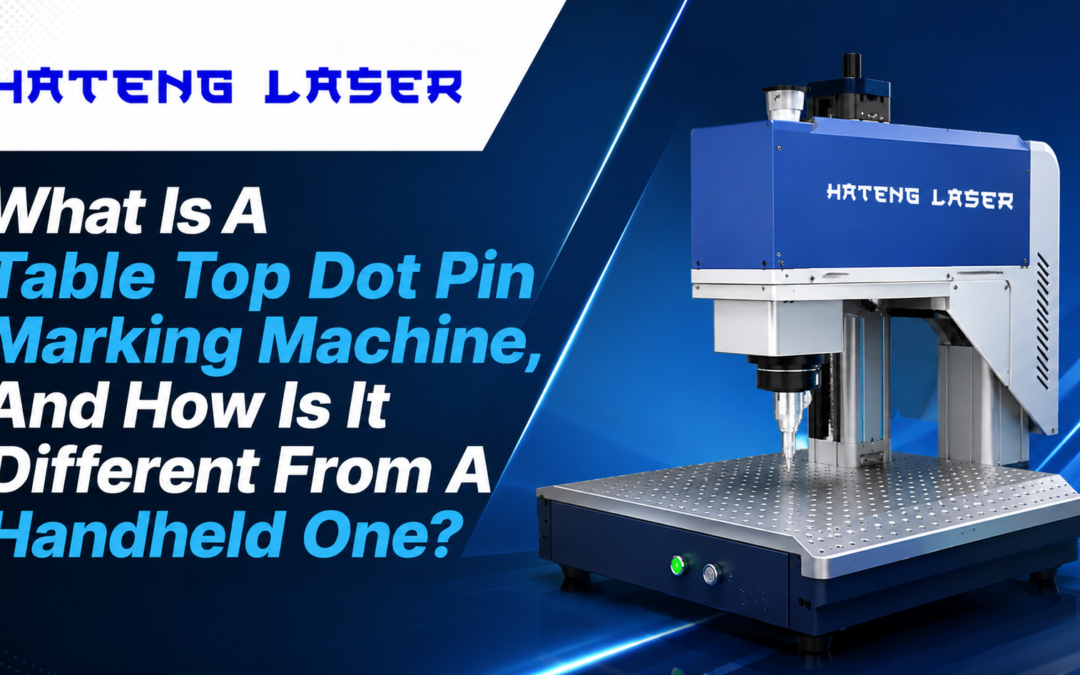
Summary
It is a bench-mounted dot peen system for permanent marking. It suits stable parts, repeat work, and higher accuracy. A handheld model is better for large, fixed, or awkward parts. Laser marking gives contact-free results, but needs a different setup. Hateng Laser helps you choose the right marking machine for the job.
Introduction
Many factories need marks that last. Part numbers, logos, and serial codes must stay readable. According to recent manufacturing workflows, traceability is now a daily requirement. That is why many teams compare a table top dot pin marking machine with other options before buying.
That choice can feel confusing. Some parts are small and easy to fix in place. Others are heavy, curved, or already installed. The wrong tool slows work. It can also leave poor marks or uneven depth.
This guide explains the main differences in simple terms. You will learn what each system does, when to use it, and where laser marking fits. You will also see how to choose the right marking machine for your plant, workshop, or service team.
What is a table top dot pin marking machine?
This bench-mounted dot peen unit uses a hard stylus to tap the surface. Those taps form dots. The dots create text, numbers, codes, or logos.
The part stays still during marking. That gives better repeatability. It also helps with neat line spacing and consistent depth. Many users prefer it for batches of identical parts.
This setup is common for metal tags, nameplates, tool parts, and industrial components. It works well where the job site has space for a fixed station. For many teams, the table top dot pin marking machine becomes the daily marking machine for controlled work.
How does it work?
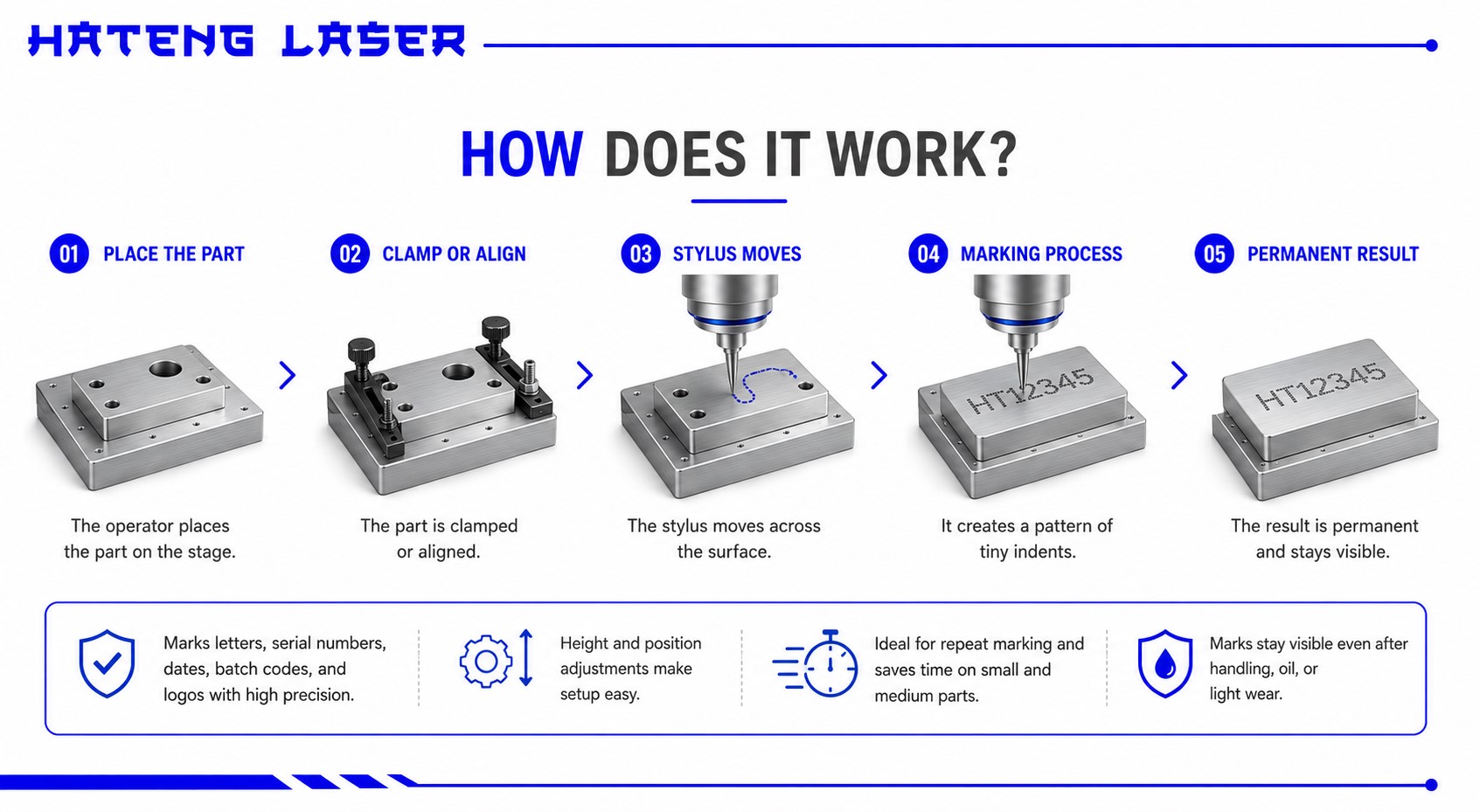
The process is simple. First, the operator places the part on the stage. Then the part is clamped or aligned. After that, the stylus moves across the surface. It creates a pattern of tiny indents.
That pattern can be very precise. The machine can mark letters, serial numbers, dates, and batch codes. It can also mark a logo. The result is permanent. It stays visible even after handling, oil, or light wear.
Because the part is fixed, setup is usually easier. The machine can be adjusted for height and position. That helps when the same component is marked again and again. In many workshops, this setup saves time on small and medium parts.
How is it different from a handheld one?
The biggest difference is control. A fixed unit stays in one place. A handheld tool moves to the part. That changes accuracy, speed, and comfort.
| Feature | Table top unit | Handheld unit |
| Mounting | Fixed on a bench | Carried to the job |
| Accuracy | Higher and more repeatable | Depends on operator steadiness |
| Part size | Best for small to medium parts | Better for large or installed parts |
| Speed for batches | Strong choice | Slower for repeated jobs |
| Skill need | Lower after setup | Higher hand control needed |
A handheld unit helps when the part is too big to move. It is also useful for repairs, pipelines, welded structures, and on-site marking. A bench model is better when the part can be placed safely on a fixture. That is why this option is often chosen for factory floors.
When is a table top model the better choice?
Choose a fixed station when your work is repetitive. It suits serial number plates, motor parts, valve bodies, tool labels, and small castings. It also suits teams that need neat, uniform output.
Best use cases for fixed marking
- Batch marking of identical parts
- Work with small or medium metal components
- Jobs that need exact alignment
- Production lines with a set marking station
- Shops that need easy operator training
A fixed setup also improves quality checks. The part can be inspected before and after marking. That reduces rejects. It also reduces rework. For many buyers, this option is the safer and cleaner choice.
What is laser marking, and where does it fit?
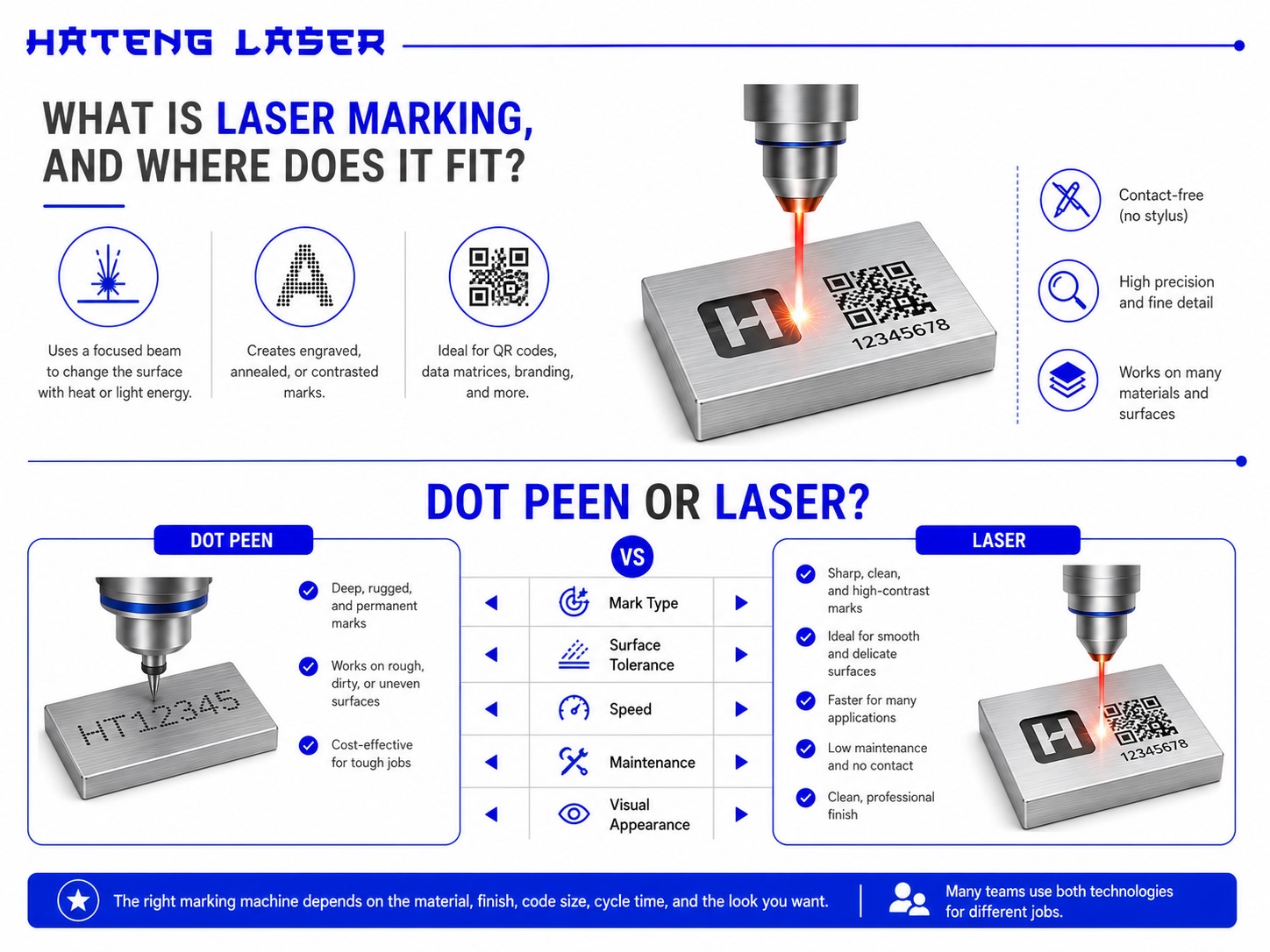
Laser marking uses a focused beam instead of a stylus. It changes the surface with heat or light energy. The result can be engraved, annealed, or contrasted on the material.
Laser systems are contact-free. That means no stylus touches the part. This helps with delicate items and very fine detail. It is also useful for QR codes, data matrices, and branding on many materials.
A dot peen unit and a laser unit solve different problems. Dot peen is strong, direct, and often cost-effective. Laser is cleaner, faster for some jobs, and highly detailed. The right marking machine depends on the material, finish, and code size you need.
Dot peen or laser?
Dot peen is often chosen for deep, rugged marks. Laser is often chosen for sharp visual contrast. If the part needs a deep tactile mark, dot peen can be better. If the part needs a polished finish, laser may be better. It also depends on cycle time, maintenance, and the look you want on the finished part. Some teams use both for different jobs.
Why should you choose Hateng Laser for marking needs?
Hateng Laser supports industrial buyers who need dependable marking solutions. The right choice depends on your parts, volume, and marking depth. A good supplier helps you match the machine to the job, not the other way around.
That matters in real production work. A nameplate shop needs different results from a fabrication unit. An automotive vendor needs different traceability from a repair team. A good marking machine should fit the workflow with minimal friction.
If you are comparing desktop and portable systems, Hateng Laser can help you narrow the options. It can also guide you on laser marking, dot peen marking, and mixed production needs. For Indian workshops and factories, that practical fit matters most.
What are the most common questions about marking machines?
What materials can be marked?
Most metals can be marked well. Some plastics can also be marked, depending on the method.
Is dot peen permanent?
Yes. It creates a physical indentation. That makes it durable and hard to remove.
Is laser marking always better?
Not always. It depends on the part, finish, and depth needed.
Can one machine do all jobs?
No single system fits every case. The best marking machine depends on your use case.
Which marking machine should you choose?
If your parts are small, repeatable, and easy to fixture, the fixed station is usually the smarter choice. It gives steady results and smoother workflow. If you need mobility, choose handheld. If you need ultra-fine detail, compare laser options too.
The best decision starts with the part itself. Look at size, material, finish, and marking depth. Then match the machine to that need. For many factories, the table top dot pin marking machine remains the most balanced option for accuracy and speed. Talk to Hateng Laser to find the right fit.