
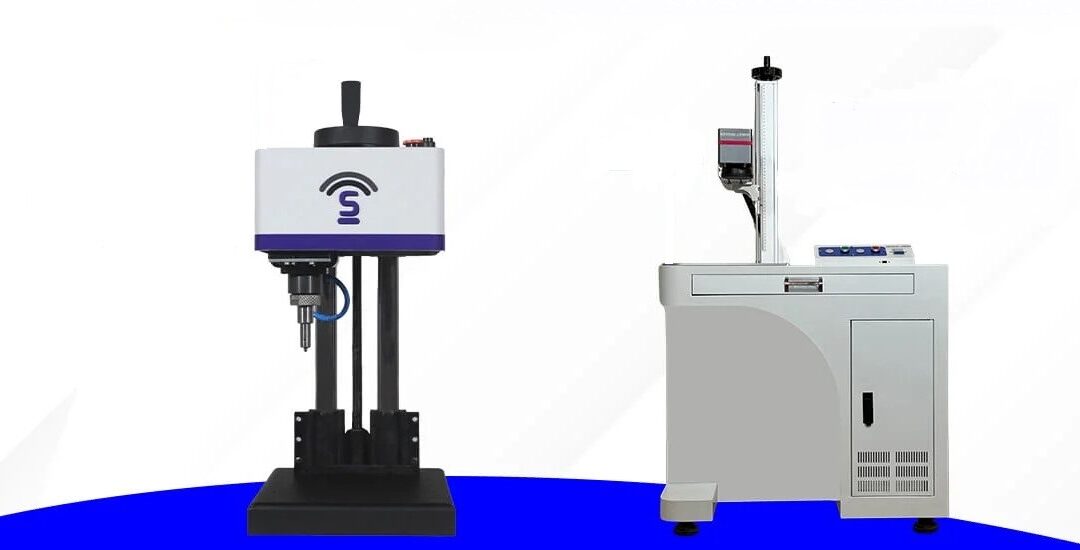
Summary: For basic, low-volume serial number marking, a ₹85,000 dot pin machine is usually worth it and often the smarter buy, because it marks deep, permanent serials on metal at a much lower upfront cost. A ₹1.6 lakh laser marking system only pays off when you need high speed, fine detail, or high volume, where its zero-consumable running cost and versatility justify the extra spend. The right marking machine depends on your volume, material, and how detailed the mark must be.
If all you need is a legible serial number stamped into a metal part, spending nearly double feels hard to justify.
And often it is. But “basic serial marking” hides a lot of variables, and the wrong call in either direction wastes money.
Let’s break down exactly what the extra ₹75,000 buys you, when it is worth it, and when the cheaper dot pin machine is the better business decision.
Is a ₹85,000 dot pin machine worth it over a ₹1.6 lakh laser for basic serial marking?
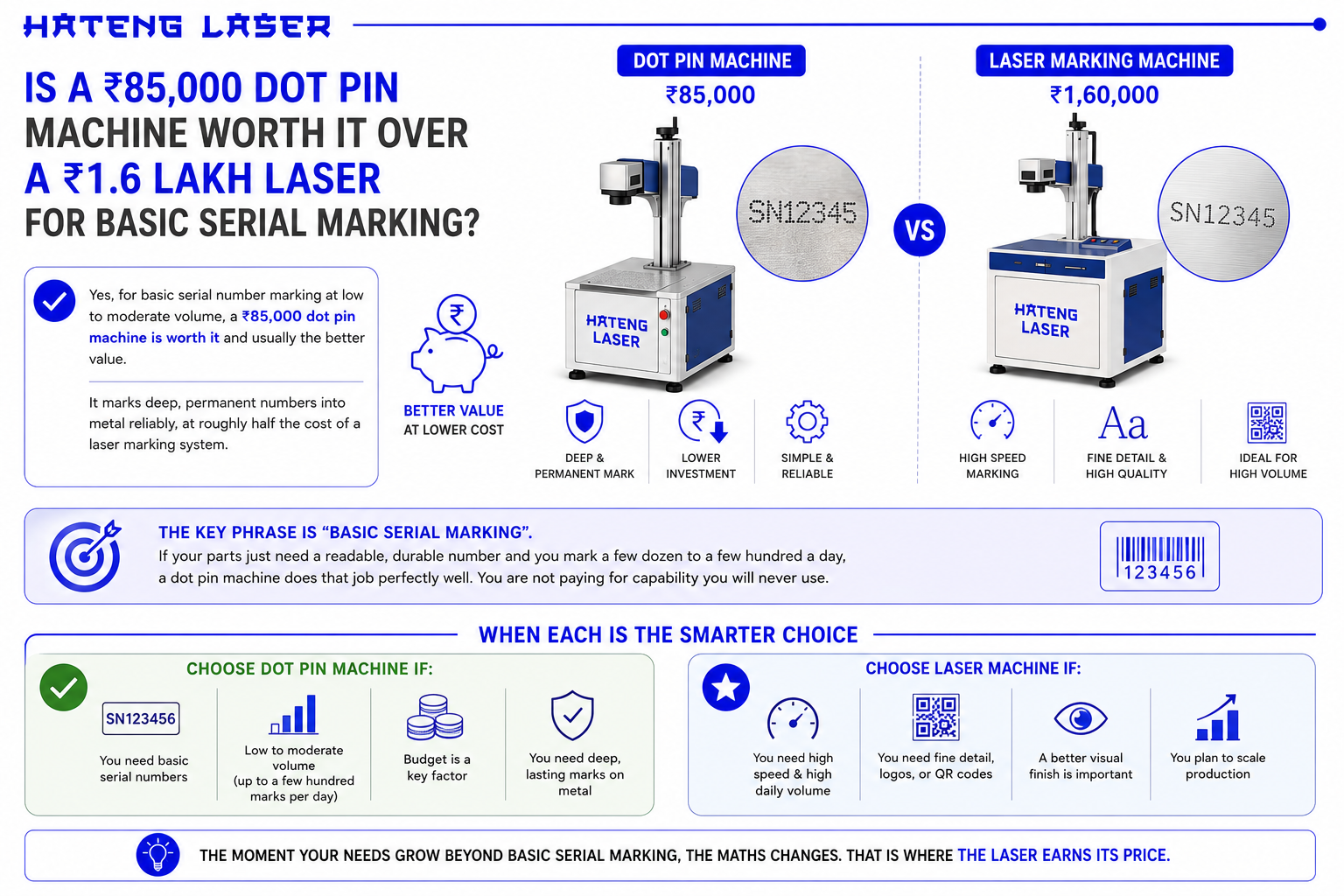
Yes, for basic serial number marking at low to moderate volume, a ₹85,000 dot pin machine is worth it and usually the better value. It marks deep, permanent numbers into metal reliably, at roughly half the cost of a laser marking system. The laser only becomes the smarter buy when speed, fine detail, or high daily volume enter the picture.
The key phrase is “basic serial marking”.
If your parts just need a readable, durable number and you mark a few dozen to a few hundred a day, a dot pin machine does that job perfectly well. You are not paying for capability you will never use.
The moment your needs grow beyond that, though, the maths changes. That is where the laser earns its price.
What do you actually get for the extra ₹75,000?
The extra ₹75,000 buys speed, fine detail, non-contact marking, and near-zero running costs. A laser marks a serial in under a second, handles tiny logos and 2D codes, never touches the part, and uses no consumables, which matters enormously at high volume.
The running-cost angle is the one buyers underestimate.
A fibre laser marking machine has a source life of at least 100,000 hours with no consumables to replace, drawing only around half a kilowatt per hour. Over years of heavy use, that adds up to real savings.
You also get versatility. A 30 watt fiber laser marking machine can mark logos, data matrix codes, and fine graphics that a dot pin simply cannot produce. If your marking needs are likely to expand, that headroom has value.
When is the ₹85,000 dot pin machine the smarter buy?
The ₹85,000 dot pin machine is the smarter buy when you need deep, rugged marks on metal, mark at low to moderate volume, or work with a tight budget. It creates indentations that survive the harshest downstream processes, which laser surface marks sometimes cannot.
Depth is its real strength.
A dot pin machine punches marks that can reach up to 1 mm deep and survive shot blasting, hot-dip galvanising, paint, and heavy wear. For structural steel, forgings, and rough castings, that durability is exactly what you want.
It is also mechanically simple. The only wear part is an inexpensive stylus tip, and operators learn it in minutes. For a small workshop marking straightforward serials on tough metal, a table top dot pin machine is often all you genuinely need.
Cost over time: which is cheaper to run?
Over time, a laser is cheaper to run per mark, while a dot pin machine is cheaper to buy. Lasers have almost no consumables and very low power draw, whereas dot pin machines only need occasional low-cost stylus tips. Your volume decides which total cost wins.
Here is how they compare across a typical working life:
| Factor | Dot pin (₹85,000) | Laser (₹1.6 lakh) |
| Upfront cost | Lower | Higher |
| Consumables | Cheap stylus tips | None |
| Running cost per mark | Low | Very low |
| Speed | Moderate | Very fast |
| Best volume | Low to moderate | High |
At a few hundred marks a day, the dot pin machine’s lower purchase price dominates and it wins overall. At thousands of marks a day, the laser’s speed and zero-consumable running cost pull ahead. Match the machine to your real throughput, not your ambition.
How should you decide for your workshop?
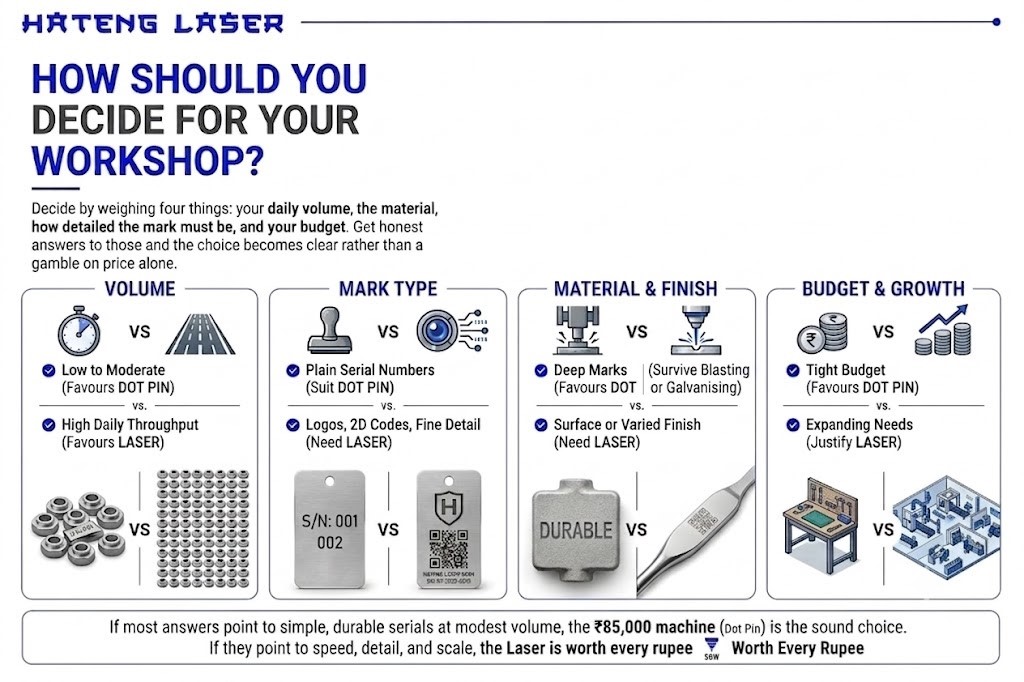
Decide by weighing four things: your daily volume, the material, how detailed the mark must be, and your budget. Get honest answers to those and the choice becomes clear rather than a gamble on price alone.
Work through them in order:
- Volume: low to moderate favours dot pin; high daily throughput favours laser.
- Mark type: plain serial numbers suit dot pin; logos, 2D codes, and fine detail need laser.
- Material and finish: deep marks that survive blasting or galvanising favour dot pin.
- Budget and growth: a tight budget favours dot pin; expanding needs justify the laser.
If most of your answers point to simple, durable serials at modest volume, the ₹85,000 machine is the sound choice. If they point to speed, detail, and scale, the laser is worth every rupee.
Frequently asked questions
Is a dot pin machine good enough for serial numbers? Yes. A dot pin machine marks deep, permanent, legible serial numbers on metal and is ideal for low to moderate volumes. For basic traceability on tough parts, it does the job reliably at a lower cost than a laser.
Why is a laser marking machine more expensive? A laser costs more because of its fibre source, galvo optics, and electronics, which enable fast, non-contact, high-detail marking. That price also buys near-zero consumables and long service life, which lowers running cost at high volume.
Can a dot pin machine mark 2D data matrix codes? Yes, a dot pin machine can mark 2D data matrix codes, but a laser produces finer, faster codes. For simple serials and basic codes at modest volume, a dot pin machine is usually sufficient and more economical.
Which lasts longer, dot pin or laser marks? Both are permanent. Dot pin marks are deeper and survive blasting, galvanising, and rough handling better, while laser marks are finer and highly durable on the surface. For extreme downstream processes, deep dot pin marks have the edge.
Is ₹85,000 or ₹1.6 lakh better value? It depends on volume. For basic serial marking at low to moderate volume, ₹85,000 offers better value. For high volume, fine detail, or logos and codes, the ₹1.6 lakh laser delivers better long-term value.
Why buyers trust Hateng Laser
Choosing between a dot pin and a laser machine is exactly the decision Hateng Laser helps buyers get right.
Rather than pushing the pricier option, the team assesses your real marking volume, material, and detail needs, then recommends the machine that fits, whether that is the HS107 table top dot pin machine or the HLF30 laser marking system. Both are built for Indian industrial conditions and backed by genuine technical support.
That practical, requirement-first approach is what makes the brand a trusted name for marking and engraving machines across engineering and manufacturing.
So, is a ₹85,000 dot pin machine worth it over a ₹1.6 lakh laser for basic serial number marking? For simple, durable serials at modest volume, yes, comfortably. Step up to speed, fine detail, or high throughput, and the laser justifies its price. Match the machine to your actual work, and either can be an excellent investment. To find the right fit for your parts and budget, talk to our team today and see a demo before you decide.