
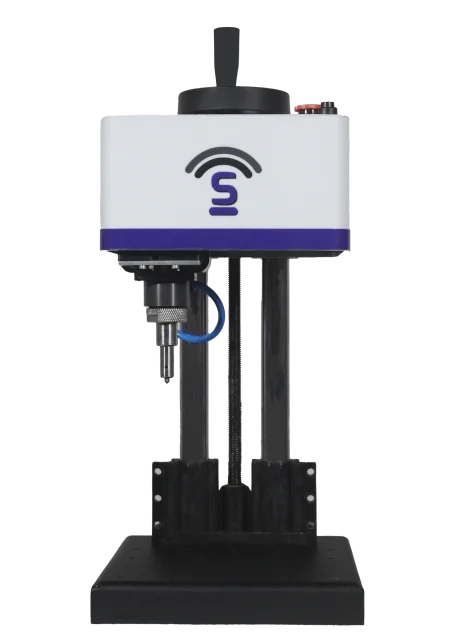
By Hateng Laser | 10 min read
If your parts fit on a bench and you mark them in batches, choose a table top laser. It holds the focus steady, gives the same result on every piece, and is easier to make safe. A handheld laser only makes sense when parts are too big or too fixed to move. For most workshops looking for an engraving machine for metal, the table top format covers far more of the work.
Key insights
- Focus is everything with a laser: a table top machine holds it, while a handheld depends on the operator holding it.
- Repeatability comes from fixturing: the same part in the same spot gives the same mark, every time.
- Safety is simpler on a bench: a fixed beam path is easier to guard than one that moves with the operator.
- Handhelds are for parts that can’t travel: large fabrications, installed equipment and site work.
Before you go
Take your three most common parts and your one biggest part. If the big one is the odd one out, build your setup around the common three and find another way to mark the big one, rather than the other way round.
Handheld laser markers look appealing in videos. Someone walks up to a big steel part, points the head, and a clean logo appears. It’s easy to think that’s the more flexible option.
On a real shop floor, though, the question is less “which looks more flexible?” and more “which gives me a good mark on my parts, every time, safely?” That’s where the two formats split.
Let’s go through how each one works, where each one wins, and how to pick the right one for the parts you actually make.
What’s the real difference between the two formats?
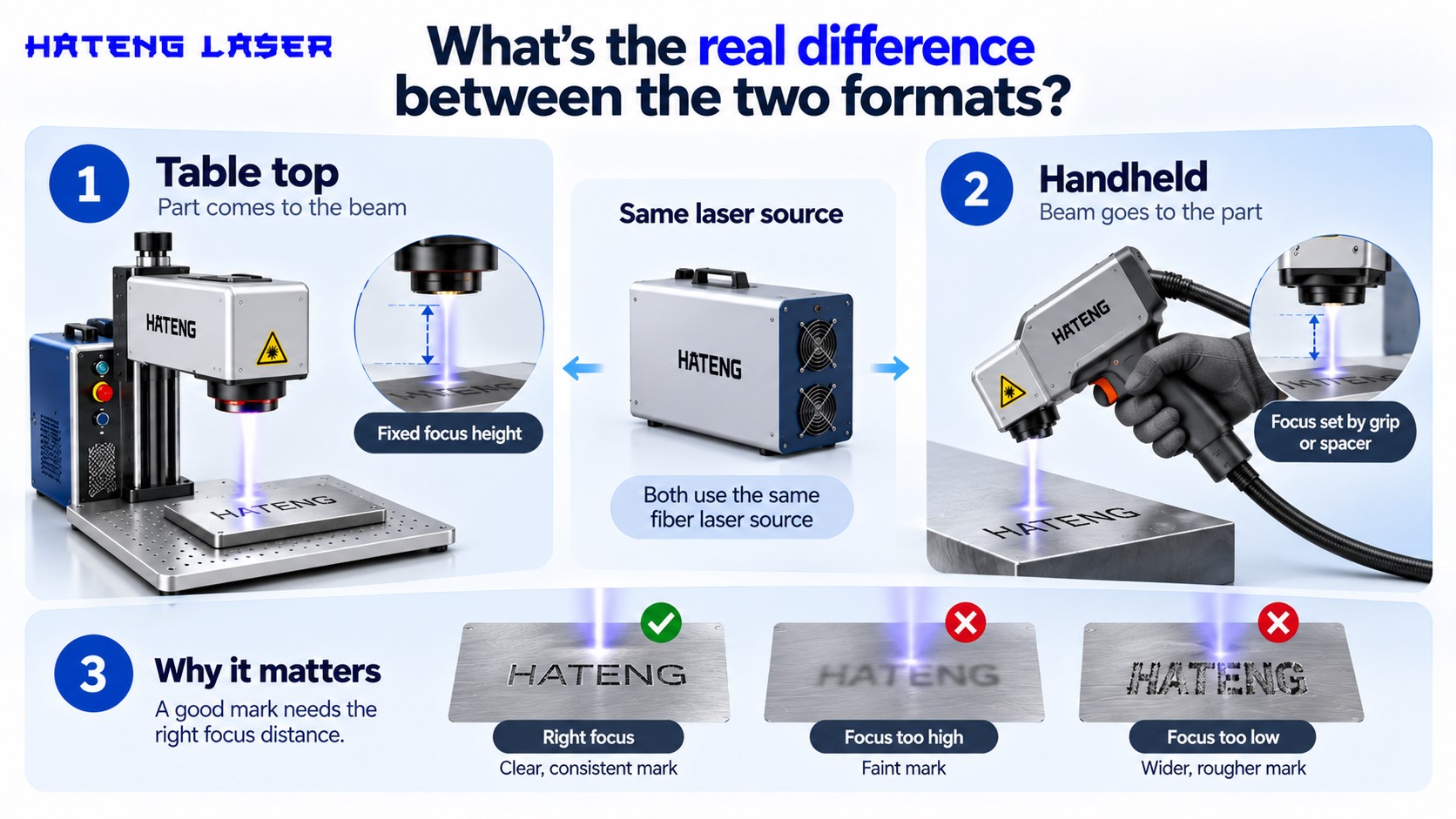
Both use the same kind of laser source. What changes is how the beam meets the part.
Table top
The laser head sits on a column above a work surface. You set the focus height once, place the part on the bed or in a fixture, and mark. The part comes to the beam.
Handheld
The laser head is in a hand unit, connected to the source by a cable. The operator holds it against or near the part. The beam goes to the part.
Why that matters
A fiber laser marks well only when the part sits at the right focus distance. On a table top machine, that distance is fixed by the setup. On a handheld, it’s fixed by the operator’s grip, or by a spacer or nose cone on the head.
| Table top | Handheld | |
| Who moves | The part goes to the beam | The beam goes to the part |
| Focus control | Set once, held by the column | Held by the operator or a spacer |
| Repeatability | High, especially with a fixture | Depends on the operator |
| Part size | Small to medium | Any, including very large |
| Safety | Easier to guard and enclose | Harder, the beam moves with the operator |
| Best for | Batches, codes, fine detail | Large or fixed parts |
How does a table top laser mark a part?
Understanding what’s inside helps explain why the table top format is so consistent.
The galvo scanner does the moving
Inside the head, two small mirrors driven by galvanometer motors, the heart of a galvo laser scanner, steer the beam across the marking field at high speed. The part stays still, and the beam does the travelling.
The F-theta lens keeps it flat
An F-theta lens focuses the beam onto a flat field, so a mark at the edge of the area is as sharp as one in the middle, as long as the part sits at the right height.
Red light preview shows where it’ll land
Before firing, a visible red light traces the outline of the mark on the part. You adjust the part until it lines up, then mark.
That’s the HLF30 setup
Hateng’s HLF30 laser marking machine comes with the machine unit and laser source, a galvo scanner with F-theta lens, EZCAD marking software, a red light preview and focus tool, and USB and power cables. It’s ready to use on delivery.
When is a table top laser the better choice?
For most metal parts in most workshops, this is where it lands.
Parts that fit on a bench
Tools, auto parts, electronic components, nameplates, fittings. If a person can pick it up and set it down, a table top machine will mark it well.
Batches and repeat jobs
With a simple fixture, every part sits at the same height and position. That means the same focus, the same mark, and very little checking.
Fine detail and codes
QR codes, Data Matrix codes, small text and logos need a steady focus and a stable part. A table top setup gives you both.
Deep engraving
Deep engraving takes several passes over the same spot. The part has to stay perfectly still between passes, which is easy on a bench and very hard by hand.
When does a handheld laser make sense?
There are real jobs where a handheld laser is the only practical route.
Very large parts
Big fabrications, long beams, large panels and heavy castings can’t go under a table top head. A handheld unit goes to them.
Installed equipment
Machines, frames and structures that are already in place need to be marked where they stand.
Low volume, high variety
If you mark a few big, different parts a week, a handheld may fit better than building fixtures for each one.
The trade-offs
You give up some consistency, because focus depends on the operator. You also take on a harder safety job, because the beam path moves around the shop with the person holding it.
How does safety differ between the two?
This deserves its own section, because it’s where the formats differ most.
Fiber lasers are invisible
Fiber lasers work in the infrared, which you can’t see. That’s why laser safety relies on classes, controlled areas and eyewear rated for the specific wavelength, not ordinary safety glasses.
A bench is easier to guard
On a table top machine, the beam points down into a fixed area. You can add guarding, a curtain or an enclosure around it, and keep people out of that one zone.
A handheld moves the risk
With a handheld, the beam can point anywhere the operator points it. Reflections off shiny metal can travel. Everyone nearby needs to be protected, not just the operator.
Fumes either way
Marking metal, and especially coated or painted metal, produces fumes. Plan for extraction near the marking point on either format. Our safety tips for laser marking operators cover eyewear, extraction and safe working habits in more detail.
| Safety point | Table top | Handheld |
| Beam direction | Fixed, downwards | Wherever the operator points |
| Guarding | Easy to add | Harder, needs a controlled area |
| Eyewear | Needed near unenclosed machines | Needed for everyone nearby |
| Fume extraction | Fixed extractor at the bench | Portable extraction needed |
What about focus and mark quality?
Focus is the hidden reason so many people end up preferring table top machines.
A small change in distance matters
A fiber laser has a fairly short zone where it’s properly in focus. Move the part a little closer or further away and the mark gets wider, fainter or patchy.
Table top: set it and forget it
Once the column height is set for a part, every identical part in the same fixture lands in the same focus zone.
Handheld: managed by spacers
Handhelds use a spacer or nose cone to set the distance. On flat parts this works fine. On curved or uneven surfaces, it’s harder to keep perfect.
How do you choose for your own parts?
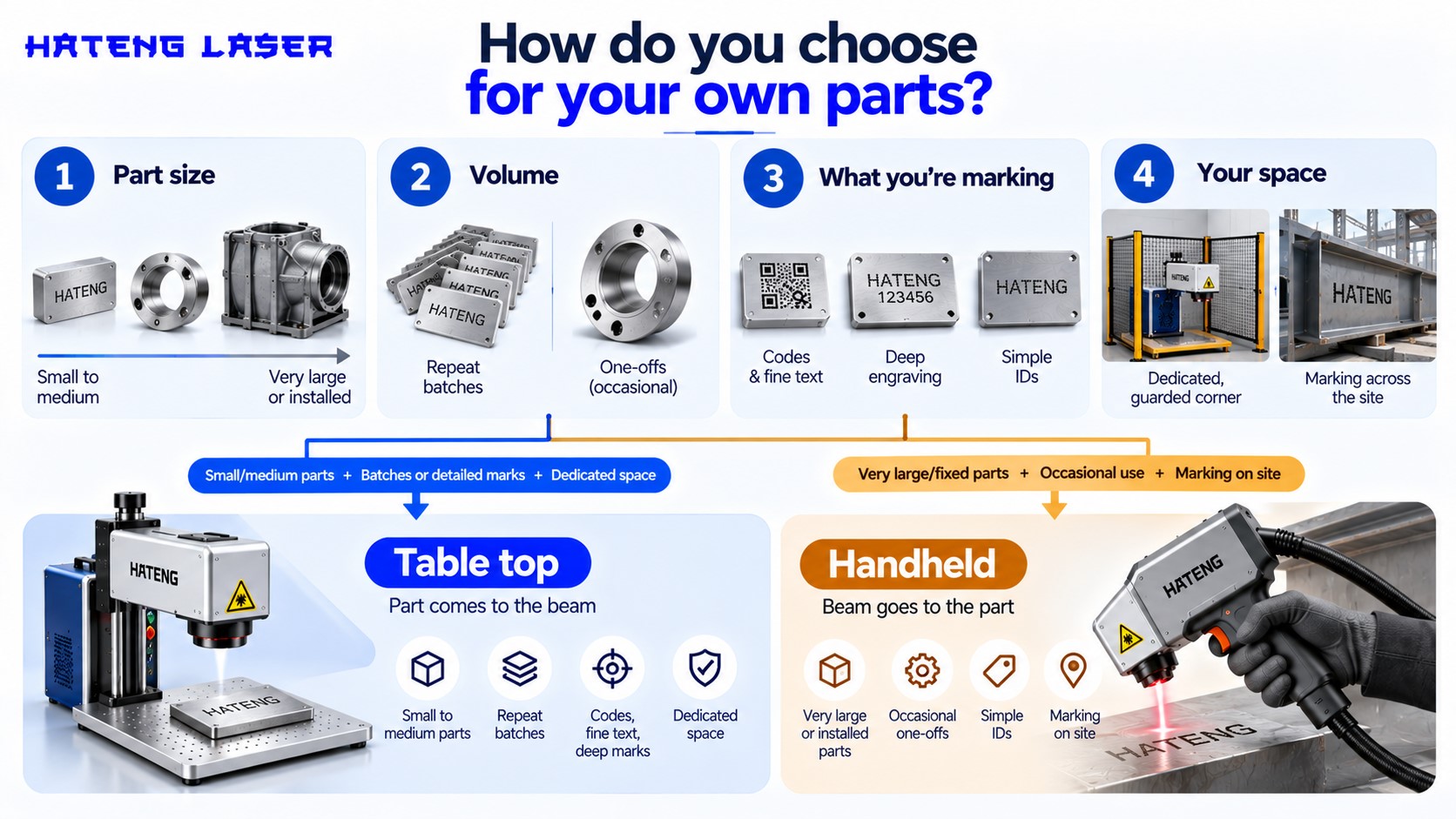
Here’s a simple way to work it out.
Step 1: Sort your parts by size
Bench-sized parts point to table top. Very large or fixed parts point to handheld.
Step 2: Look at your volume
Repeat batches favour table top every time. A few one-off big parts a week might suit handheld.
Step 3: Check what you’re marking
Codes, fine text and deep engraving need a steady setup, so table top. Simple IDs on big parts can work handheld.
Step 4: Think about your space
If you can give the laser its own guarded corner, a table top machine fits neatly. If marking happens all over the site, think carefully about safety before going handheld.
Our comparison of desktop and industrial laser engraving machines is a useful follow-on if you’re also weighing up machine size.
| Your parts | Your volume | Best format |
| Small to medium | Batches | Table top |
| Small to medium | One-offs | Table top |
| Very large or installed | Occasional | Handheld |
| Mixed, mostly small | Batches | Table top, with another method for the big ones |
Wrapping up
Handheld lasers are a good answer to one specific problem: parts that can’t move. For everything else, and that’s most workshops’ work, a table top laser gives steadier focus, more repeatable marks and a simpler safety setup.
If your parts fit on a bench, start there. Hateng Laser’s HLF30 is built around that table top approach, with a galvo scanner, F-theta lens, red light preview and EZCAD software, and it’s specified for serial numbers, QR and Data Matrix codes, logos, deep engraving on metal, and anodised and coated surfaces.
Send a few of your parts to Hateng Laser, including the biggest one you’d want to mark. We’ll show you how the HLF30 handles them, and be straight with you if one of them is a job for a different setup.
FAQs
What is the difference between a handheld and a table top laser marking machine?
A table top machine holds the laser head on a column above a fixed work area, so parts come to the beam. A handheld moves the head to the part by hand. Table top gives steadier focus and repeatability.
Is a handheld laser marker good for small parts?
It can work, but a table top machine usually does better on small parts. Small parts need a steady focus and precise positioning, which a fixed column and fixture provide far more reliably than a hand.
Which laser marking machine is better for QR codes?
A table top machine. QR and Data Matrix codes need a stable part and a consistent focus distance to scan reliably. A fixed head and a simple fixture make that much easier than marking by hand.
Are handheld laser markers safe?
They can be used safely with the right controls, but they need more care. The beam moves with the operator, so everyone nearby needs suitable eyewear, and the marking area must be controlled. Table top machines are easier to guard.
Can a table top laser engrave deep marks on metal?
Yes. Deep engraving uses multiple passes over the same area, and a table top setup keeps the part perfectly still between passes. The HLF30 is specified for deep engraving on metal as one of its applications.
Does Hateng Laser sell a handheld laser marking machine?
Hateng Laser’s laser machine is the HLF30, built around a table top style setup with a galvo scanner and F-theta lens. If your parts need a handheld format, talk to the team about whether the HLF30 suits them.