Summary
For permanent serial number marking, industrial is usually the better choice. For small, low-volume jobs, compact desktop-style machines can work well. On metal, a 30 watt fiber laser marking machine is a strong practical entry point. Hateng positions fibre lasers as the best fit for metals and serial codes. In India, price and service support matter as much as power.
Introduction
India’s manufacturing activity is still moving. According to PIB, manufacturing growth reached 5.4% in July 2025, while IIP grew 3.5%. That keeps permanent part marking important for factories and engineering workshops.
Many buyers face the same question. They want a compact engraving machine laser for small batches. They also want marks that stay readable on metal parts.
This guide clears that confusion. You will learn which machine suits serial numbers, where a 30 watt fiber laser marking machine fits, and how to choose for Indian production needs.
What do desktop and industrial laser engraving machines mean?
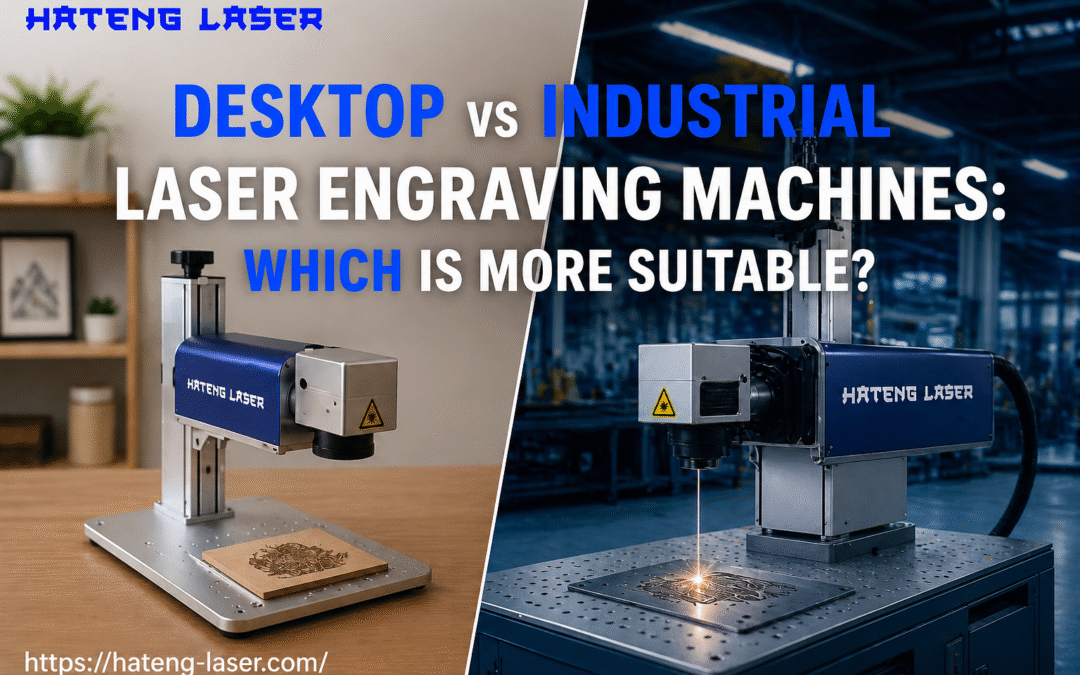
“Desktop” usually means compact, lower-cost, and space-saving. Hateng’s cost guide describes entry-level / portable & desktop fiber markers in the ₹1.1 lakh to ₹1.6 lakh band. It also says these are suitable for small jobs and light industrial use.
“Industrial” means machines built for heavier duty cycles. Hateng describes laser marking machines as ranging from low-cost portable units to high-end industrial systems. Its homepage also frames its offering as industrial laser and dot peen marking.
| Factor | Desktop-style machine | Industrial machine |
| Typical use | Small jobs, light production | Serial numbers, traceability, production work |
| Space | Compact | Larger, more robust |
| Price band | Lower entry band | Mid to high industrial bands |
| Best fit | Occasional marking | Repeatable production marking |
That difference matters in real buying. A compact machine may fit your desk. An industrial machine may fit your workload better.
Which is more suitable for permanent serial number marking?
For permanent serial number marking, industrial is usually more suitable. Hateng says laser markers create permanent, high-contrast marks with micron-level precision and excellent repeatability. It also says these marks are preferred for traceability and branding.
Hateng’s fibre laser content is even more direct. It says fibre lasers are the metal marking powerhouse and work well on stainless steel, aluminium, titanium, and brass. It also says 30-watt fibre models are preferred for power, cost, and adaptability.
Why industrial wins here
- Better repeatability for batch work
- Better fit for metal serial numbers
- Better for traceability workflows
- Better long-term value for production use
A desktop-style machine can still help. It is useful when you mark small batches or simple identifiers. But for permanent serial numbers on metal, industrial is the safer choice.
How do they compare on precision, speed, and durability?
Hateng says laser marking is non-contact and low-consumable. It also says laser markers create permanent marks with excellent repeatability. That supports clean serial-number output on production parts.
Hateng’s 30W fibre article says those machines can engrave neatly on most metals. It adds that they can reach speeds up to 10,000 mm/s in suitable setups. It also says they support small to medium-sized objects well.
| Performance factor | Desktop-style machine | Industrial machine |
| Precision | Good for light jobs | Strong for serials and logos |
| Speed | Lower-duty use | Faster industrial marking |
| Durability | Adequate for smaller workloads | Better for repeat production |
| Metal marking | Limited by power and scale | Strong on metals |
For metal parts, fibre is the key word. Hateng and its product pages consistently position fibre as the strongest option for serials, logos, and industrial marking.
How much does a 30 watt fiber laser marking machine cost in India?
The 30 watt fiber laser marking machine is often the practical sweet spot. Hateng says a 30W fibre unit offers a balance of power, cost, and adaptability for many tasks. It also says it suits stainless steel, aluminium, brass, and titanium.
Pricing snapshot
| Category | Typical India price | Best use |
| Entry-level / portable & desktop fibre markers | ₹1.1 lakh to ₹1.6 lakh | Small jobs and light industrial use |
| Mid-range industrial markers | ₹2 lakh to ₹4 lakh | Regular production marking |
| High-end industrial systems | ₹5 lakh to ₹15+ lakh | Automation and specialised needs |
Hateng lists its HLF130 at ₹1,60,000 ex-works. The listing describes a fibre laser marking setup with a Galvo scanner and software included. Hateng says prices are ex-works and can change.
So what does that mean for buyers? If you need one machine for steady metal serial marking, a 30W industrial fibre unit is often the best value. If you only need occasional marking, a compact desktop-style unit can be enough.
Which machine fits Indian use cases best?
Indian buyers usually choose by material and volume. Hateng says fibre lasers suit metal marking, while CO2 suits non-metals like wood, leather, paper, and glass. It also highlights serial numbers, barcodes, logos, and regulatory information as core laser marking uses.
Best-fit use cases
- Automotive parts in Pune or Chennai: industrial fibre laser.
- Tool shops in Ahmedabad or Rajkot: industrial fibre laser or 30W fibre unit.
- Small fabrication units in Bhiwandi or Delhi: compact desktop-style fibre marker.
- Mixed branding and packaging work: CO2 or a separate non-metal system.
Hateng is based in Bhiwandi, Maharashtra, and presents itself as an Indian manufacturer of marking and engraving machines. That local positioning matters when service, ex-works pricing, and support are part of the purchase.
Why should Hateng-Laser be on your shortlist?
Hateng’s own pages focus on precision, portability, and performance. It offers both laser marking machines and table top dot pin machines, which helps buyers compare industrial marking options in one place.
Its content also supports a practical buying process. Hateng provides a cost guide, machine type explanations, and fibre laser guidance for metals. It also says a 30W fibre laser is a strong balance of power and cost.
For serial number marking, that is useful. It gives you a realistic route from shortlist to sample test. That is exactly how industrial buyers should compare an engraving machine laser.
Contextual CTA: If your parts are metal and your serials must stay readable, check products and ask for a sample mark on your own component. That is the fastest way to compare desktop and industrial fit.
What do people also ask?
Is a desktop laser engraving machine good for serial numbers?
Yes, for small batches and lighter use. For permanent serial numbers on metal, an industrial fibre machine is usually better because it offers stronger repeatability and traceability.
Is a 30 watt fiber laser marking machine enough for metal?
Yes, Hateng says 30W is a balanced choice for many metal jobs. It suits stainless steel, aluminium, brass, and titanium, especially for serials and logos.
What is the difference between fibre and CO2 for metal marking?
Fibre is the better choice for metal. Hateng says CO2 is better for wood, leather, paper, glass, and other non-metals.
How much does a laser marking machine cost in India?
Hateng’s guide shows entry-level desktop or portable fibre markers around ₹1.1 lakh to ₹1.6 lakh, mid-range industrial units around ₹2 lakh to ₹4 lakh, and high-end systems from ₹5 lakh upwards.
Conclusion
For permanent serial number marking, the better answer is usually industrial laser engraving. It suits metal parts, production work, and traceability better than a small desktop machine. Hateng’s fibre laser guidance supports that choice clearly.
A desktop-style machine still has a place. It is useful for smaller budgets, limited space, and lighter workloads. But once the job becomes repetitive and metal-focused, industrial becomes the smarter investment.
For many Indian buyers, the sweet spot is a 30 watt fiber laser marking machine. It balances cost, speed, and metal-marking quality well. If you are comparing options, Hateng-Laser is a sensible brand to review first.
Final CTA: Book demo or talk to expert before buying, so you can test your actual part and confirm the right machine.