
Summary
A practical hourly cost for a fibre laser machine in India is often around ₹5 to ₹8 per hour for electricity only, if the machine draws about 500W to 800W. Hateng’s HLF130 is listed with input power under 800W. If you also spread a ₹475 monthly fixed charge over about 200 operating hours, the all-in hourly cost rises to roughly ₹7 to ₹10 per hour in a Maharashtra industrial tariff example. Hateng’s HLF130 is a 30W fibre laser marking machine built for serial numbers, QR codes, logos, barcodes, and auto parts, with a listed ex-works price of ₹1,60,000. If your job volume is low, a dot peen engraving machine or dot pin marking machine may suit you better, especially when the marking method matters more than laser speed.
Introduction
HLF130 runs on 220V AC, single phase, and the input power is listed at under 800W. That is the right starting point for any hourly cost estimate.
The tricky part is that many buyers confuse laser source wattage with full machine power. A 30W fibre laser source is not the same as the whole machine’s electricity draw. That difference changes the real running cost.
This guide shows the hourly cost, the calculation method, and the point where a fibre laser becomes cheaper than outsourcing or using a dot peen style machine.
What does a fibre laser machine really consume?
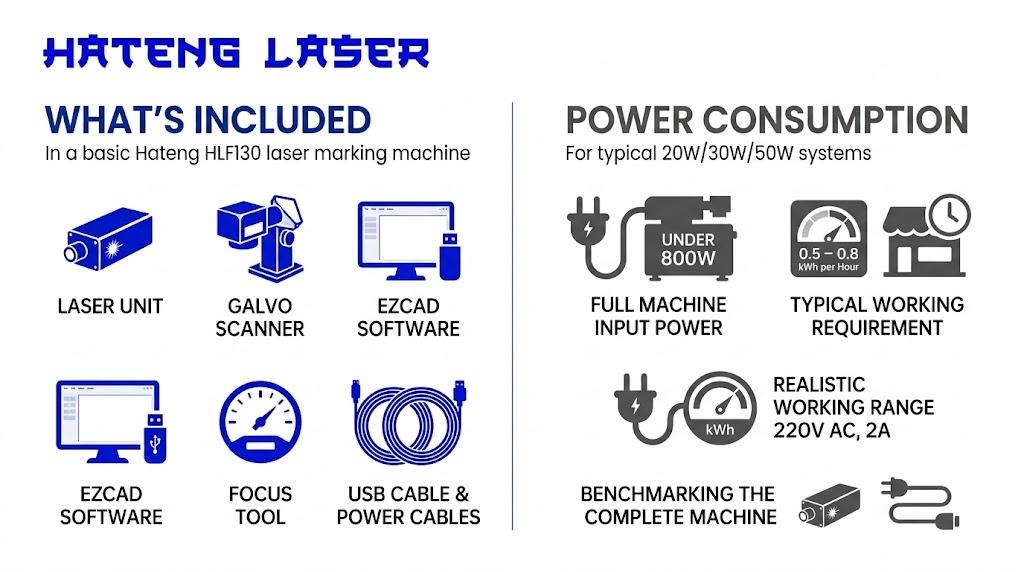
The HLF130 is a laser marking machine for serial numbers, QR codes, logos, barcodes, and auto parts. The machine includes the laser unit, galvo scanner, EZCAD software, focus tool, USB cable, and power cables.
For power, a useful benchmark is the full machine input, not just the laser source. The input power is under 800W. Another industrial 20W/30W/50W fibre laser specification lists power consumption around 500W and a 220V AC, 2A requirement.
That gives a realistic working range. In normal shop-floor use, a fibre laser machine often sits somewhere between 0.5 kWh and 0.8 kWh per hour of operation, depending on the model and workload.
How much does one hour of electricity cost?
A current Mumbai licence-area industrial tariff sheet from Tata Power shows LT III(A) energy charge at ₹6.50/kWh and wheeling charge at ₹3.15/kWh. That gives a variable electricity cost of ₹9.65 per kWh before fixed charges.
Using that reference, the hourly electricity cost becomes straightforward.
| Assumed machine draw | Calculation | Electricity cost per hour |
| 500W | 0.5 × ₹9.65 | ₹4.83 |
| 650W | 0.65 × ₹9.65 | ₹6.27 |
| 800W | 0.8 × ₹9.65 | ₹7.72 |
So the clean answer is this. Electricity-only running cost is usually about ₹5 to ₹8 per hour for a fibre laser machine in this setup. The exact number depends on actual load, not just laser wattage.
What is the all-in hourly cost after fixed charges?
The same Tata Power industrial tariff sheet shows a fixed charge of ₹475 per month for LT III(A). If you run the machine for 200 hours a month, that fixed charge adds about ₹2.38 per hour.
That changes the picture.
| Assumed machine draw | Electricity-only cost | Fixed charge per hour* | All-in hourly cost |
| 500W | ₹4.83 | ₹2.38 | ₹7.21 |
| 650W | ₹6.27 | ₹2.38 | ₹8.65 |
| 800W | ₹7.72 | ₹2.38 | ₹10.10 |
*At 200 operating hours per month. If your machine runs more, the fixed charge per hour drops. If it runs less, the fixed charge per hour rises.
That is why buyers should not look only at the tariff per unit. Utilisation changes the real cost very quickly. A machine running 50 hours a month will look expensive per hour. A machine running daily will look far cheaper.
Does the cost change by job type and material?
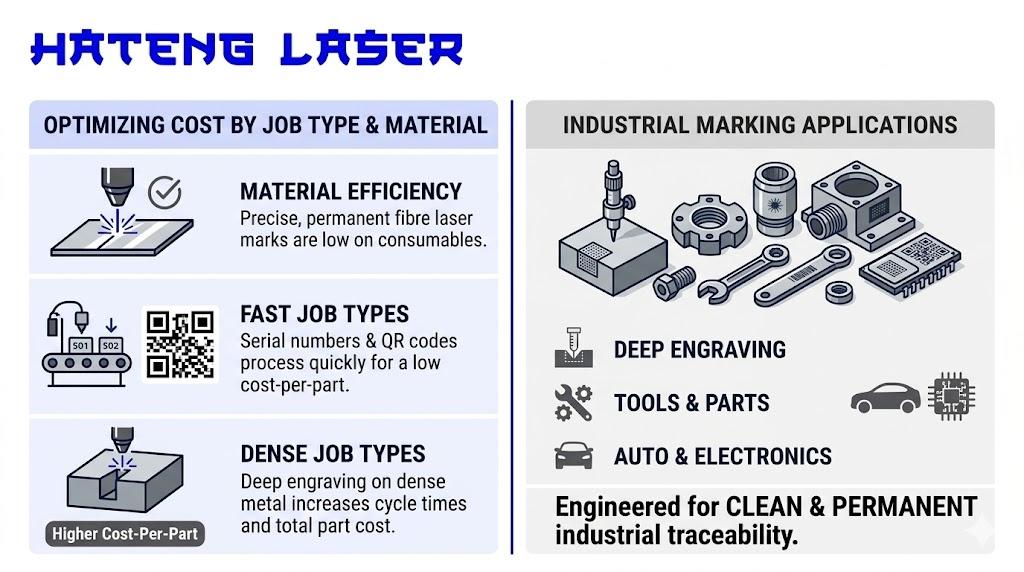
Yes. A fibre laser machine is usually chosen because it is precise, permanent, and low on consumables. The HLF130 is suitable for deep engraving on metal, coated surfaces, tools, auto parts, and electronic components.
If you mark serial numbers or QR codes, the machine may work quickly and spend little time on each part. If you engrave dense metal, cycle time can rise. That means your cost per part increases even if the hourly cost stays the same.
For engineering tools and auto parts, fibre laser marking often makes sense because the mark is permanent and clean.
When are dot peen engraving machine and dot pin marking machine cheaper?
A dot peen engraving machine or dot pin marking machine can be cheaper when your job is heavy, rugged, or intermittent. Pneumatic dot peen models need compressed air, while electric models only need a regular power outlet.
That means dot peen can reduce electricity use in some setups, but it may add compressor cost. So the true running cost depends on whether you already have compressed air on the shop floor.
| Marking option | Best for | Cost pattern |
| Fibre laser | Fast, precise, permanent marks | Higher upfront cost, low per-part electricity use |
| Dot peen | Deep, rugged marks on metal | Lower laser-style power need, may use compressed air |
| Dot pin marking machine | Simple direct part marking | Often better for heavy industrial use and traceability |
If your workload is mostly serial coding, fibre laser is usually the better productivity tool. If your parts need deep impact marking, dot peen may be the more economical engineering tool.
What should buyers in Bhiwandi, Thane, and Mumbai do next?
If you are near Bhiwandi, Thane, or Mumbai, the smartest move is to test your real parts. HLF130 is a ready-to-use, with a 1-year machine warranty and 1-year laser source warranty. The company also lists its factory address in Bhiwandi.
Ask for a live demo on your actual material. Then compare the hourly electricity estimate, the marking speed, and the expected output per shift. That gives a more useful ROI view than price alone.
For many buyers, the real answer is simple. A fibre laser machine is often cheap to run per hour, especially when it works every day. The cost becomes even better when it replaces outsourcing or secondary processing.
People also ask
What is the hourly electricity cost of a 30W fibre laser machine in India?
A practical reference range is about ₹5 to ₹8 per hour for electricity alone, using a 500W to 800W machine draw and a Maharashtra industrial tariff example.
Is fibre laser cheaper to run than a dot peen engraving machine?
Often yes for marking speed and repeatability. But dot peen may be simpler on rugged metal parts, especially if compressed air is already available on site.
How much power does Hateng’s HLF130 use?
Hateng lists the HLF130 with 220V AC, single-phase input and under 800W input power.
Does the hourly cost include fixed electricity charges?
Not always. Electricity-only cost uses the unit rate. If you spread the monthly fixed charge across your operating hours, the all-in hourly cost goes up.
So, what is the final answer?
For India, a fibre laser machine’s running cost per hour is usually modest. Using a Maharashtra industrial tariff reference, electricity-only cost is about ₹5 to ₹8 per hour, and all-in cost can land around ₹7 to ₹10 per hour after spreading fixed charges.
For Hateng’s HLF130, that makes the machine practical for serial numbers, auto parts, tools, and industrial marking work. If you want a direct comparison with a dot peen engraving machine or dot pin marking machine, the best decision usually comes down to part type, duty cycle, and whether compressed air is already available.
Talk to Expert.