Summary: Fiber laser marking is a non-contact process that uses a focused beam of infrared light to create permanent marks on metal and some plastics, without ever touching the part. The laser source generates light through a doped fibre optic cable, which a set of mirrors then steers across the surface to burn, discolour, or engrave the material in a precise pattern. It is fast, needs no consumables, and produces marks that survive years of wear, which is why it has become the standard for serial numbers, logos, barcodes, and traceability codes across manufacturing.
If you have never worked with one, “fiber laser marking machine” can sound more complicated than it actually is. There is no cutting fluid, no physical stylus, and no ink involved.
It is, at its core, a beam of light doing a very controlled, very precise job on a metal surface. Once you understand the basic mechanics, the rest, choosing wattage, understanding what it can and cannot mark, becomes much easier to reason about.
What Exactly Is Fiber Laser Marking?
Fiber laser marking is a process that uses an infrared laser beam, generated inside a fibre optic cable, to permanently alter the surface of a material and create a visible mark. Unlike ink-based printing or a physical stamping tool, nothing physically touches the part.
The “fiber” in the name refers to how the laser light is generated and delivered. Inside the machine, a fibre optic cable doped with rare-earth elements like ytterbium acts as the laser’s gain medium, amplifying light until it becomes a focused, high-energy beam. That beam is then guided out through the marking head onto your part.
How Does a Fiber Laser Marking Machine Actually Work?
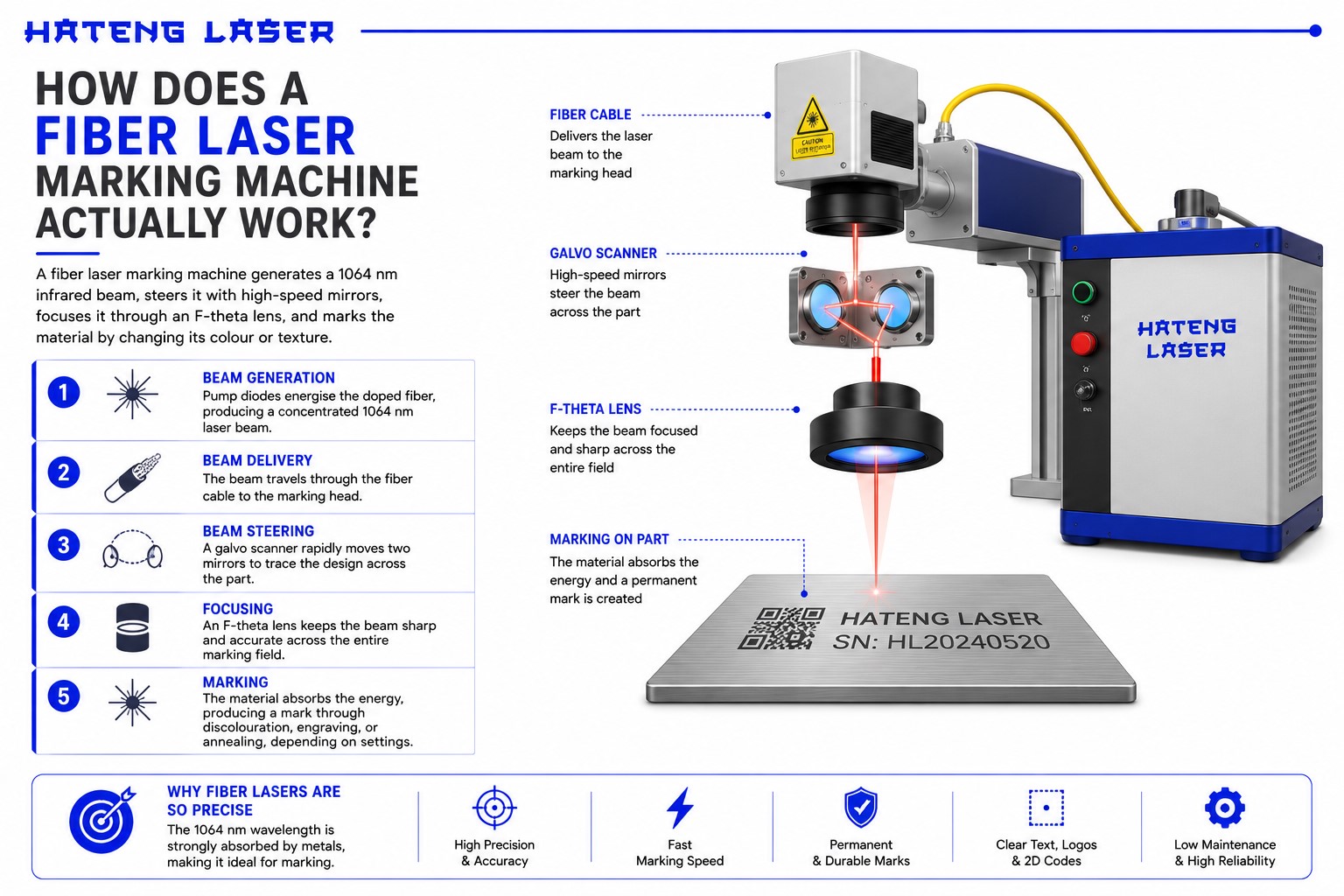
A fiber laser marking machine works by generating a 1064 nanometre infrared beam inside a doped fibre cable, then steering that beam across a part using a pair of computer-controlled mirrors, known as a galvo scanner, focused through an F-theta lens. Wherever the beam lands, the metal absorbs the energy and changes colour or texture, leaving a permanent mark.
The process, step by step:
- Beam generation: pump diodes energise the doped fibre, producing a concentrated 1064 nm laser beam.
- Beam delivery: the beam travels through the fibre to the marking head.
- Beam steering: a galvo scanner rapidly moves two mirrors to trace the design across the part.
- Focusing: an F-theta lens keeps the beam sharp and accurate across the entire marking field.
- Marking: the material absorbs the energy, producing a mark through discolouration, engraving, or annealing, depending on settings.
This is why fiber lasers are so precise. The 1064 nm wavelength penetrates and is strongly absorbed by metals, which is exactly the wavelength range that makes fiber the standard choice for marking steel, aluminium, brass, and plated components.
What Kinds of Marks and Materials Can a Fiber Laser Handle?
A fiber laser marking machine can produce several distinct types of marks depending on the power and settings used, ranging from surface-level discolouration to deep, physical engraving. The type you choose depends on what the mark needs to survive.
| Mark Type | What It Does | Best For |
| Annealing | Heats metal below the surface, leaving a dark mark without breaking the surface | Stainless steel, medical parts, food-contact items |
| Engraving | Removes a thin layer of material, creating a raised or recessed mark | Deep marks needing high contrast |
| Etching | Melts the surface slightly to raise a textured mark | Fast marking, good visibility |
| Colour marking | Uses controlled heat to produce black, white, or coloured marks | Branding, logos, decorative marking |
Fiber lasers mark most metals effectively, including stainless steel, mild steel, aluminium, brass, titanium, and plated or coated surfaces, along with select plastics that respond to the 1064 nm wavelength. Metals are where fiber lasers genuinely excel, since the wavelength is strongly absorbed by metallic surfaces.
Not every material is a good match. Fiber lasers generally struggle with clear plastics, glass, and some organic materials, where a CO2 laser, which uses a longer wavelength, tends to perform better. For a metal-marking workshop, though, fiber is almost always the right technology.
Why Has Fiber Laser Marking Become So Widely Used?
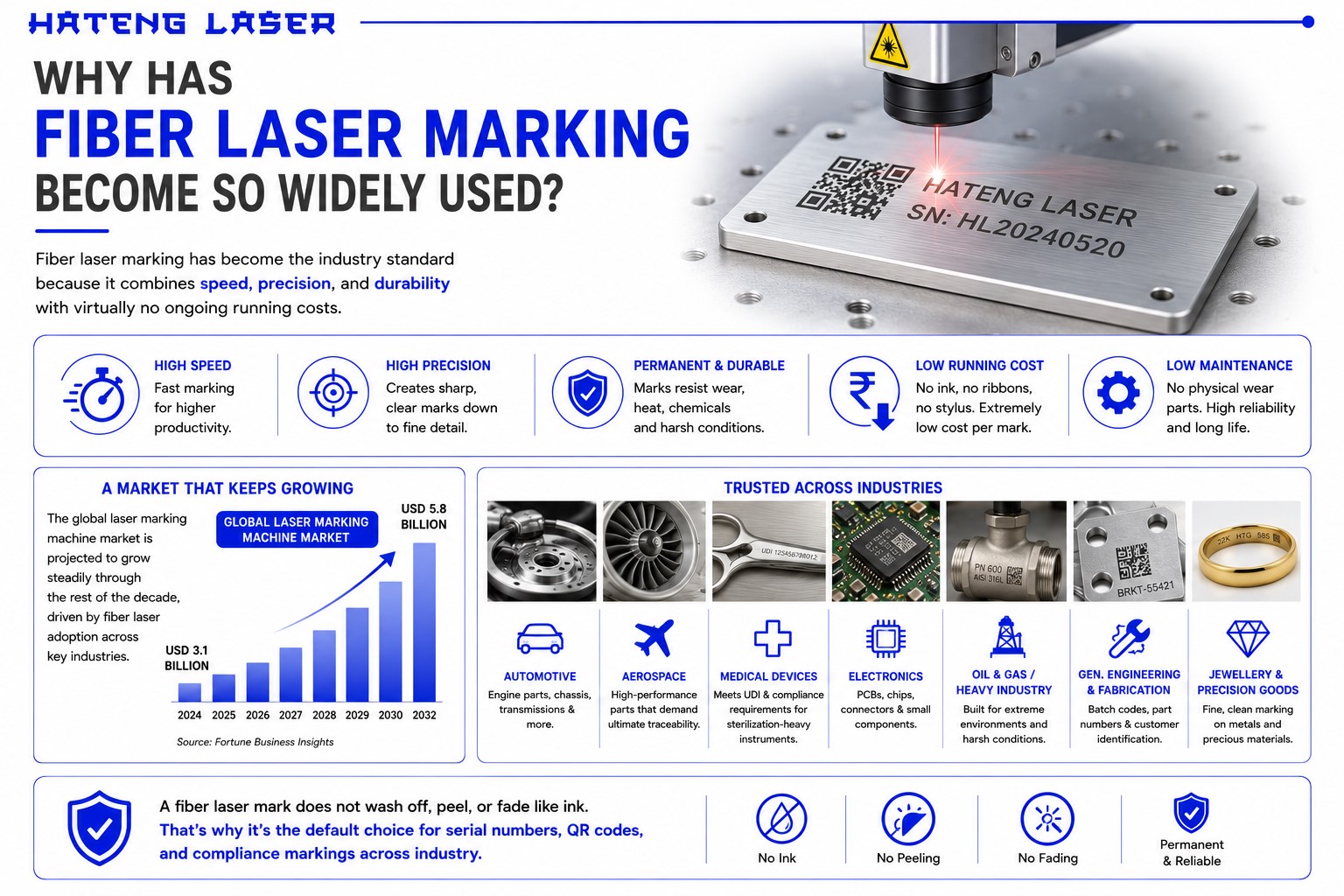
Fiber laser marking has become the industry standard because it combines speed, precision, and durability with virtually no ongoing running costs. There is no ink to replenish and no physical wear part like a stylus tip, which keeps the cost per mark extremely low over the machine’s working life.
Demand for the technology reflects that shift. The global laser marking machine market is projected to grow steadily through the rest of the decade, driven largely by fiber laser adoption in electronics, automotive, and general manufacturing, sectors that increasingly need permanent, machine-readable codes rather than printed labels that can peel or fade.
For manufacturers, that durability matters practically. A fiber laser mark does not wash off, peel, or fade the way ink-based printing can, which is exactly why it has become the default choice for serial numbers, QR codes, and compliance markings across industry.
Getting Started With Fiber Laser Marking
For a workshop new to the technology, the starting decision is usually wattage. A 20W to 30W fiber laser handles most serial number, logo, and 2D code marking on standard metals comfortably, while higher wattage machines suit thicker engraving or faster cycle times on high-volume lines.
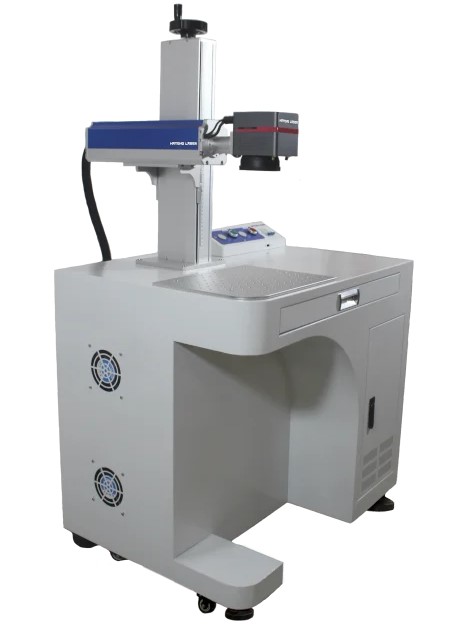
The HLF30 fiber laser marking machine is built around exactly this entry point, a 30 watt system capable of marking serial numbers, logos, and 2D codes cleanly on steel, aluminium, and brass, with the low running cost that makes fiber technology worth the initial investment.
Frequently Asked Questions
Is fiber laser marking permanent? Yes, fiber laser marks are permanent under normal use. Depending on the mode used, annealing, engraving, or etching, the mark either alters the surface chemically or physically, and none of these wash off, fade, or peel like ink-based marking can.
Does fiber laser marking damage the part? No, when set correctly. Annealing and light etching are non-destructive to the part’s structural integrity, since the process only affects a thin surface layer. Deep engraving removes more material but is still controlled and predictable.
Can a beginner operate a fiber laser marking machine? Yes. Modern fiber laser marking machines use straightforward design software, and most operators learn the basics of loading a design and adjusting settings within a day or two of training, without needing an engineering background.
How is fiber laser marking different from laser engraving? Laser engraving is one type of mark a fiber laser can produce, physically removing material to create a deep, textured mark. Fiber laser marking is the broader term covering all mark types the machine can produce, including engraving, annealing, and etching.
What wattage fiber laser do I need for basic serial numbers? A 20W to 30W fiber laser marking machine is generally sufficient for serial numbers, logos, and basic 2D codes on standard metals like steel and aluminium. Higher wattage is only needed for deeper engraving or very high-speed production lines.
Why Buyers Trust Hateng Laser
Understanding how fiber laser marking actually works is the first step to choosing the right machine, and that is exactly where Hateng Laser starts every conversation with a new buyer.
Rather than leading with a wattage number, the team walks you through what your parts, material, and volume actually require, then matches you to the right system, whether that is the HLF30 fiber laser marking machine or a dot pin alternative for simpler needs. Every machine is built for Indian industrial conditions and backed by genuine local support.
That straightforward, education-first approach is what makes Hateng Laser a trusted name for marking and engraving machines across engineering and manufacturing. If you are weighing up fiber laser marking for your workshop, talk to our team today and see the process on your own parts before you decide.