
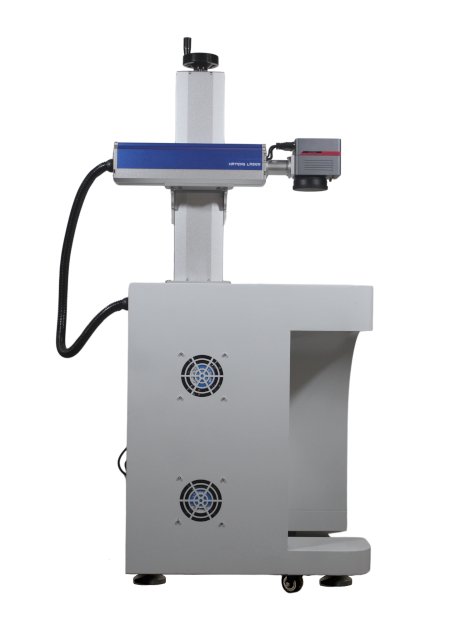
I remember the first time I saw a laser beam cut through steel. It wasn’t in a sci-fi movie. It was inside a factory floor, where a slim red dot danced across the surface of a metal plate, leaving behind crisp, permanent marks. No scratching, no ink. Just pure precision. That’s the magic of a laser marking machine.
But let’s slow down. What exactly is it? And how does it work?
The Basics of Laser Marking
At its core, a laser marking machine is a tool that uses concentrated beams of light to alter the surface of a material. The laser doesn’t just draw—it changes the very composition of the surface, leaving behind a mark that’s permanent.
Unlike printing, it won’t fade. Unlike stickers, it won’t peel. Unlike manual etching, it doesn’t wobble.
That’s why industries—from automotive to electronics—swear by it.
A Short Story From the Floor
A manufacturer once told me, “We used to spend hours etching serial numbers manually. The workers got tired. The results weren’t consistent. Now, with a marking machine, the job that took 3 hours is done in 15 minutes.”
That’s the point. Speed. Accuracy. Repeatability.
Numbers don’t lie. According to MarketsandMarkets, the laser marking industry was valued at USD 3.2 billion in 2022 and is projected to reach USD 4.6 billion by 2027, growing at a CAGR of 7.3%. The demand is exploding.
How Does a Laser Marking Machine Work?
Here’s the simple version.
- A laser beam is generated inside the machine.
- The beam is focused using mirrors or fiber optics.
- When the beam hits the material, heat, chemical change, or discoloration happens.
- A mark is created—whether it’s a number, a logo, or even a barcode.
Different methods exist—like engraving, annealing, foaming, or carbon migration—but the concept is the same. Precision by light.
And if you’ve seen an engraving machine for metal, you know how clean those marks look. No burrs, no rough edges. Just smooth, permanent text or design.
Why Do Businesses Prefer Laser Marking?
Because it lasts. Because it saves money in the long run. Because it’s versatile.
Take an engraving machine for metal. Metal is hard, unforgiving. You can’t just stamp it casually. But laser? It cuts right through, leaving behind a perfect mark without wearing down tools.
In fact, surveys show that nearly 60% of manufacturers prefer laser systems over traditional engraving due to durability and low maintenance costs.
And let’s be honest. The engraving machine price might seem high at first—anywhere between $2,500 to $50,000 depending on the technology (fiber, CO₂, UV). But over time, it pays back. No inks. No consumables. Almost zero downtime.
A Peek Behind the Scenes: Different Types of Laser Marking
Here’s where it gets interesting. Not all machines are the same.
- Fiber Lasers – Best for metals. Fast, long-lasting, and widely used in automotive, aerospace, electronics.
- CO₂ Lasers – Great for plastics, wood, glass, leather. Often used in packaging.
- UV Lasers – Ultra-precise. Perfect for delicate materials like silicone, plastics used in medical devices.
So when people ask, “Why is the engraving machine price so different?”—that’s why. It depends on what you need it for.
Real-World Applications
Think about the last time you bought a smartphone. See that IMEI number engraved neatly at the back? That’s a laser mark.
Or the batch number on your medicine strip. The barcode on your laptop battery. The logo on a car engine part.
All from marking machines. Quietly ensuring traceability, authenticity, and compliance with international standards.
The Final Thought
This isn’t slowing down. With industries demanding more automation, laser marking is blending into robotic arms, AI-driven assembly lines, and IoT-enabled tracking.
By 2030, experts predict over 70% of manufacturing companies will integrate laser marking machines into their workflow. It’s not just about marking anymore. It’s about traceability, safety, and branding.
I should say this—it’s not flawless. Machines need calibration. If you choose the wrong type of laser, materials can burn or discolor. And the upfront cost? Yes, it’s steep.
But in the long run, businesses rarely regret the investment.
FAQs
Q1: What is the difference between laser engraving and laser marking?
Laser engraving removes material to create deep marks, while laser marking changes the surface appearance without removing material. Both use lasers but achieve different results.
Q2: How much does an engraving machine price usually cost?
It depends on the type. Fiber lasers for metals may start at around $3,000, while advanced UV lasers can go up to $50,000 or more.
Q3: Can a laser marking machine work on all materials?
Not all, but most. Metals, plastics, ceramics, glass, and even some organics like wood or leather can be marked.
Q4: Why should manufacturers invest in an engraving machine for metal instead of traditional methods?
Because it’s faster, more accurate, and cost-effective in the long term. Traditional engraving tools wear out. Lasers don’t.
Q5: Is a marking machine safe to use?
Yes, but with precautions. Operators must use safety goggles, and machines should be enclosed or shielded.