
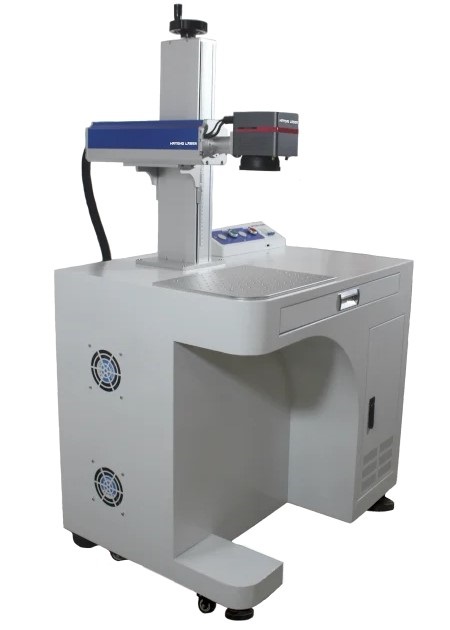
Summary: A galvo scanner is a pair of fast, mirror-mounted galvanometers that steer the laser beam across the part, while the F-theta lens focuses that beam onto a perfectly flat plane. Together they keep the spot size, focus, and energy identical across the whole marking area, which is what gives you sharp, uniform marks from edge to edge. In a fiber laser marking machine, this pairing is the single biggest factor in mark quality and speed, and it is what separates the best fiber laser systems from cheap ones.
Two machines can share the same laser source and produce very different results.
The difference usually lives in the beam-steering optics, the galvo scanner and F-theta lens, which most buyers never think to ask about.
Get this part right and every mark is crisp, consistent, and fast. Get it wrong and marks blur or fade towards the corners of the field. Here is how it actually works.
What is a galvo scanner with an F-theta lens?
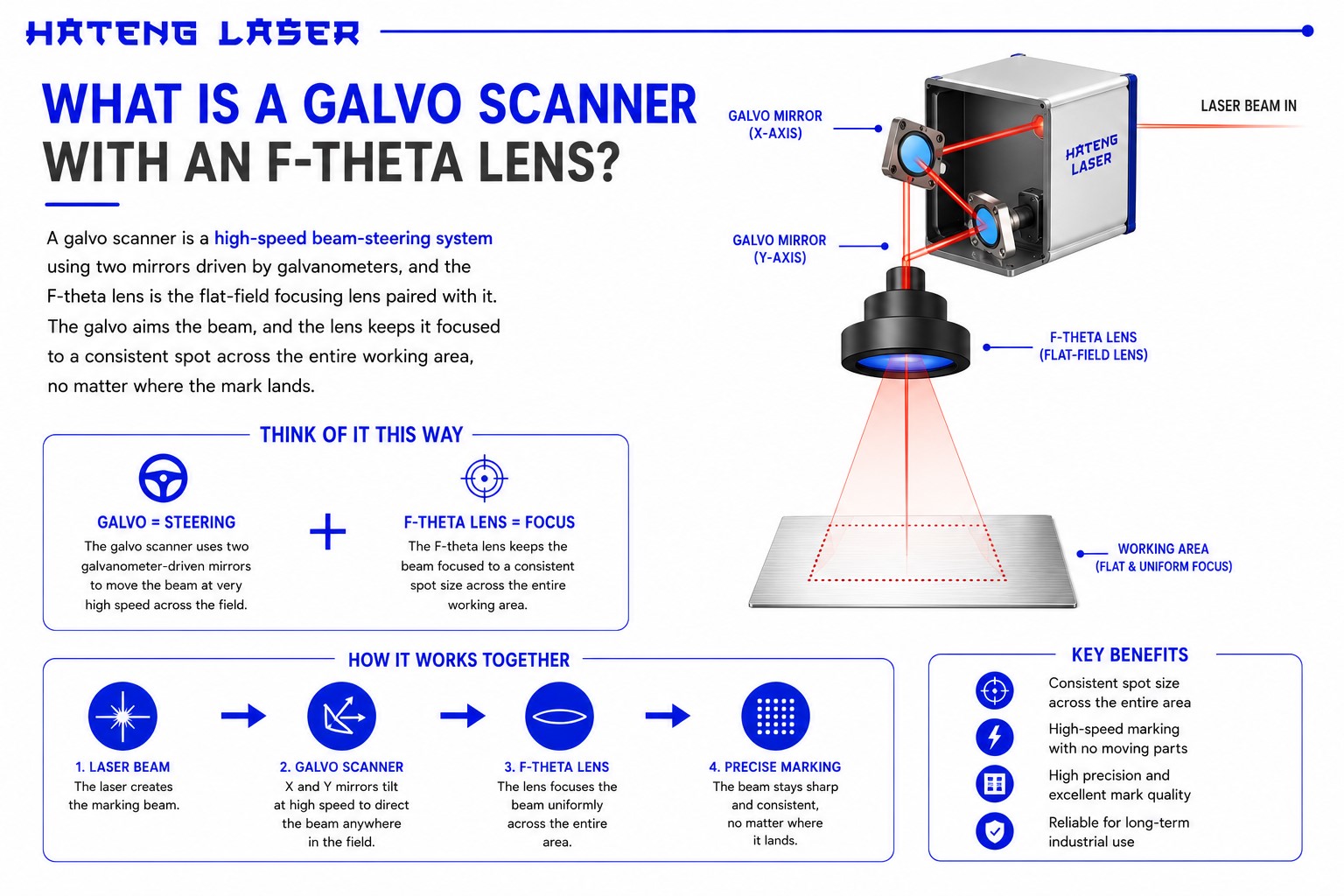
A galvo scanner is a high-speed beam-steering system using two mirrors driven by galvanometers, and the F-theta lens is the flat-field focusing lens paired with it. The galvo aims the beam, and the lens keeps it focused to a consistent spot across the entire working area, no matter where the mark lands.
Think of the galvo as the steering and the lens as the focus.
The galvanometers tilt two tiny mirrors, one for the X axis and one for the Y axis, incredibly fast. This lets the beam jump anywhere in the field in fractions of a millisecond, with no moving part touching the workpiece.
The F-theta lens then does the crucial job of keeping that fast-moving beam sharp everywhere it goes.
How does a galvo scanner work in a fiber laser marking machine?
A galvo scanner works by reflecting the laser beam off two mirror-mounted galvanometers that rotate to position the beam anywhere within the marking field. Because only lightweight mirrors move, the beam can be steered at extremely high speed, allowing a fiber laser marking machine to mark serials and codes in a fraction of a second.
Speed is the headline benefit.
There is no gantry or head physically travelling over the part. The mirrors simply tilt, so the beam repositions almost instantly. That is why galvo-based marking machines are so much faster than moving-head systems.
This speed is only useful, though, if the mark stays sharp wherever the beam points. On its own, a galvo would focus that beam onto a curved surface. Something has to flatten it.
Why does the F-theta lens matter for quality?
The F-theta lens matters because it corrects the natural curvature a galvo creates, focusing the beam onto a flat plane with a uniform spot size. Without it, marks would be sharp in the centre and blurred or weak at the edges, ruining consistency across the marking field.
This is the heart of mark quality.
When mirrors deflect a beam, it naturally wants to focus on a curved plane, not a flat part. The F-theta lens adds deliberate barrel distortion so the spot lands on a flat field, with beam displacement kept linear to the mirror angle. In plain terms, it keeps focus and spot size constant everywhere.
That uniformity is what gives you identical mark depth, contrast, and sharpness in every corner of the field, not just the middle. For consistent serials and readable codes, it is non-negotiable.
How does this affect mark quality and speed?
Together, the galvo and F-theta lens deliver uniform, high-contrast marks at very high speed. Because the spot size and energy stay constant across the field, every character has the same quality, and the fast mirrors let the machine mark quickly without sacrificing that consistency.
The numbers show why it works so well.
A quality fibre system focuses to a spot of around 20 to 40 microns and can scan at speeds up to roughly 10,000 mm per second on high-end units, with metal serial plates commonly running around 1,500 mm per second. That combination of a tiny, uniform spot and rapid scanning is what produces fine, fast, repeatable marks.
For laser mark appliances, nameplates, and traceability codes, this means clean results at production speed rather than a trade-off between the two.
What should you check when buying a galvo-based marking machine?
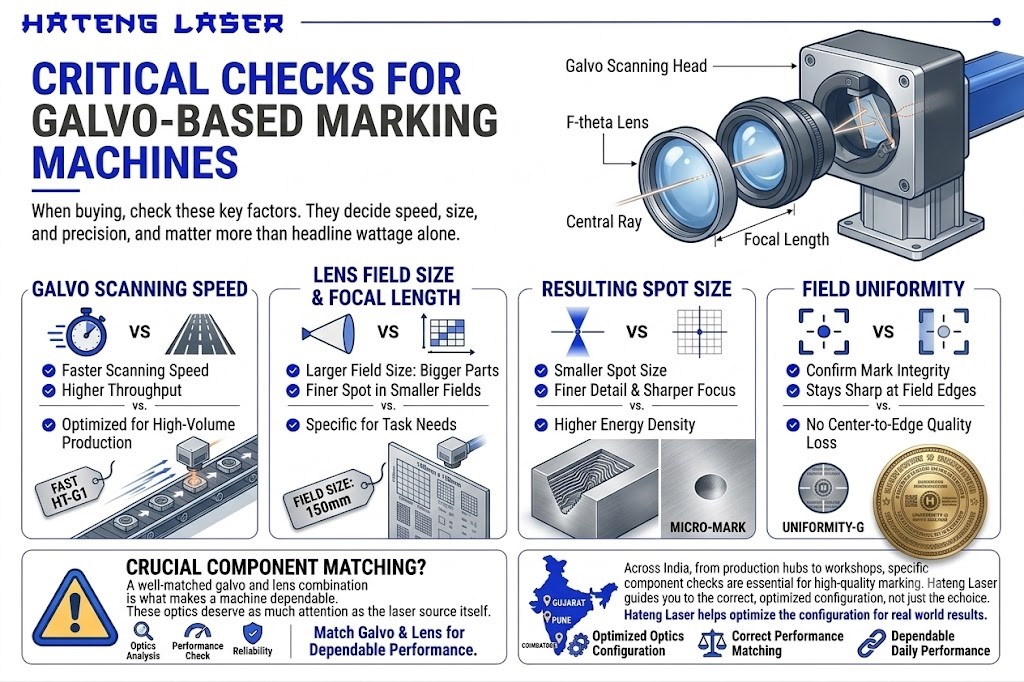
When buying, check the galvo scanning speed, the F-theta lens focal length and field size, and the resulting spot size. These decide how fast, how large, and how fine your marks can be, so they matter more than headline wattage alone.
Focus on these points:
- Galvo speed: faster scanning means higher throughput on high-volume lines.
- Lens field size: a larger field marks bigger parts, but a smaller field gives a finer spot.
- Spot size: a smaller spot produces finer detail and higher energy density.
- Field uniformity: confirm the mark stays sharp at the field edges, not just the centre.
A well-matched galvo and lens combination is what makes a machine dependable day after day. When choosing a laser marking machine, these optics deserve as much attention as the laser source itself.
Frequently asked questions
What does a galvo scanner do in a laser marking machine? A galvo scanner steers the laser beam using two fast-moving mirrors, positioning it anywhere in the marking field almost instantly. This lets the machine mark serials, logos, and codes at high speed without any part physically touching the workpiece.
Why is an F-theta lens necessary? An F-theta lens is necessary because a galvo alone focuses the beam onto a curved plane. The lens flattens that focus, keeping spot size and energy uniform across the whole field, which ensures sharp, consistent marks everywhere, not just the centre.
Does the F-theta lens affect mark quality? Yes, significantly. The F-theta lens keeps the laser spot uniform across the entire marking area, so mark depth, contrast, and sharpness stay consistent from edge to edge. Poor lens quality causes blurred or weak marks toward the field corners.
What spot size does a fiber laser produce? A quality fiber laser marking machine typically focuses to a spot of around 20 to 40 microns. A smaller spot produces finer detail and higher energy density, which is important for marking small text, fine logos, and 2D data matrix codes.
How fast can a galvo laser marking machine mark? Galvo laser marking machines are very fast, marking a serial or code in under a second. High-end systems scan at speeds up to around 10,000 mm per second, while metal serial plates commonly run near 1,500 mm per second.
Why buyers trust Hateng Laser
Because optics decide quality as much as the laser source, Hateng Laser makes the galvo and F-theta lens part of the conversation rather than hiding it behind a wattage figure.
The team helps buyers understand what actually drives mark quality, then matches the right configuration to the parts and field size they need, with the HLF30 laser marking machine built for consistent, edge-to-edge results in Indian industrial conditions. Everything is backed by genuine technical support and demos.
That transparent, quality-first approach is what makes the brand a trusted name for laser marking machines across engineering and manufacturing.
So, why does a galvo scanner with an F-theta lens matter for quality? Because it keeps every mark sharp, uniform, and fast across the entire field, which is the whole point of a precision marking machine. When you compare systems, look past the wattage and ask about the optics. To see the difference in person, talk to our team today and book a marking demo on your own parts.