
Summary: Laser marking machines are used across automotive, aerospace, medical devices, electronics, oil and gas, general engineering, and jewellery and precision goods, wherever a part needs a permanent, machine-readable identifier that survives its working life. The common thread across all seven industries is traceability, regulators, customers, or internal quality systems increasingly require every critical part to carry a code that can be scanned, verified, and traced back through production.
Laser marking has moved from a niche capability to a near-default requirement across a wide range of manufacturing sectors. The reasons vary by industry, sometimes it is regulatory compliance, sometimes it is warranty tracking, sometimes it is simply that ink and labels do not survive the environment a part ends up in.
Here are the seven industries where laser marking machines have become standard equipment, and why each one relies on the technology.
The 7 Industries
1. Automotive Manufacturing
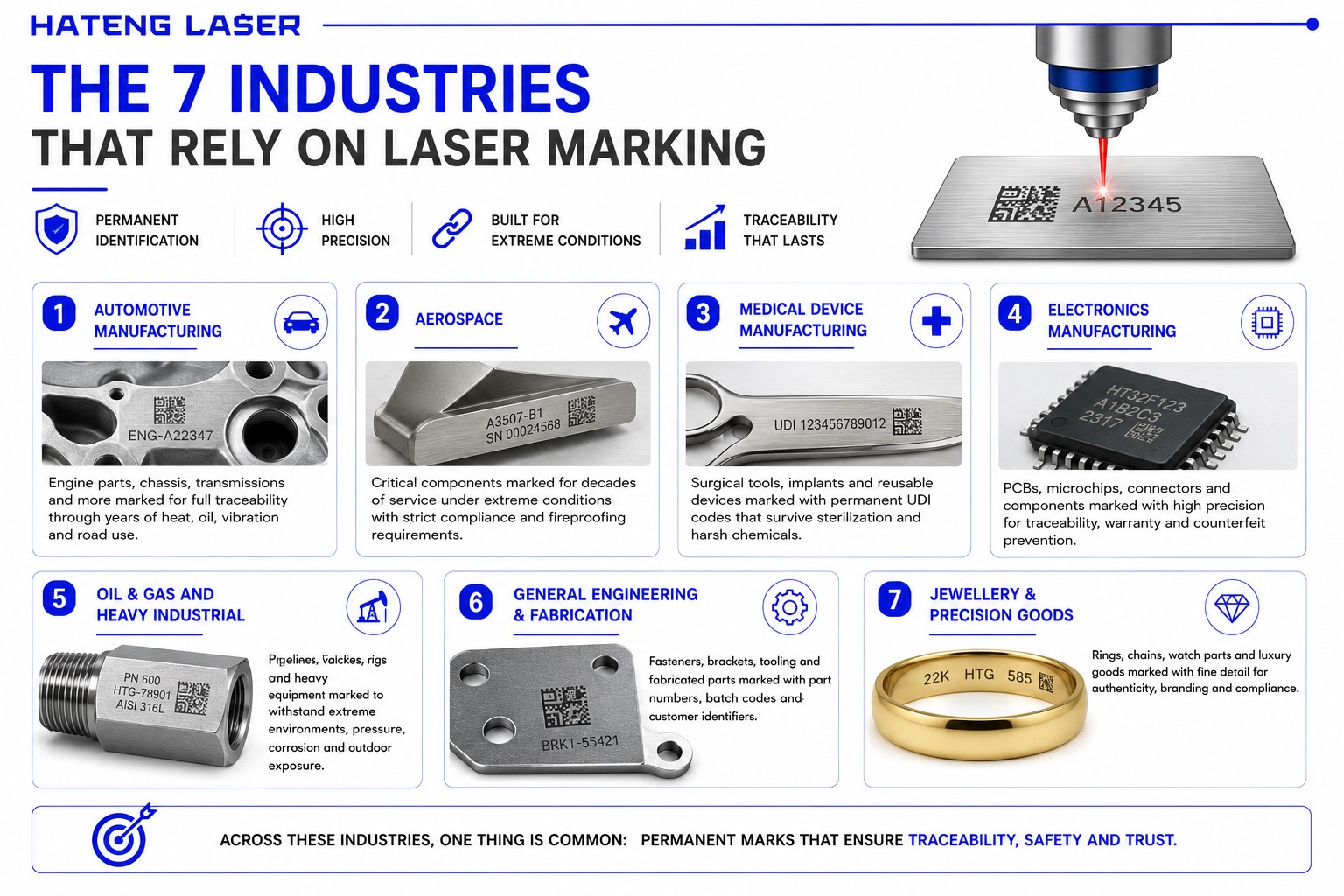
Automotive manufacturers mark engine components, chassis parts, transmissions, and countless other components that require permanent traceability through the vehicle’s entire working life. Marks need to survive heat, oil, vibration, and years of road use without becoming illegible.
Much of this demand is driven by quality standards rather than choice. Automotive quality frameworks such as IATF 16949 mandate strict direct part marking, requiring critical components to carry a permanent, machine-readable code that supports full lot and part-level traceability, often retained for ten to fifteen years after production.
2. Aerospace
Aerospace components are marked for the same core reason as automotive parts, traceability and compliance, but under even stricter conditions. Parts must be identifiable throughout decades of service, survive extreme temperature cycles, and in many cases withstand fireproofing requirements that rule out ink or adhesive labels entirely.
Laser marking suits this environment because it produces a permanent mark without adding material or altering the part’s certified properties, which matters enormously in a regulated industry where every component’s history has to be provable.
3. Medical Device Manufacturing
Medical device manufacturers rely on laser marking to meet direct part marking requirements for surgical instruments, implants, and reusable equipment, where the mark has to survive repeated sterilisation cycles and harsh cleaning chemicals without fading. This is not optional in most markets.
In the United States, FDA regulations under 21 CFR 801.45 require reusable medical devices to carry a permanent Unique Device Identifier directly on the device itself, readable both by a human and by an automated scanner. Laser marking is one of the few technologies that reliably meets both requirements on small, sterilisation-heavy instruments.
4. Electronics Manufacturing
Electronics manufacturers use laser marking on PCBs, microchips, connectors, and resistors, often on parts small enough that other marking methods simply cannot achieve the required precision. Component traceability matters here for warranty tracking, recall management, and increasingly, counterfeit prevention.
India’s electronics sector has grown fast enough to make this demand structural rather than incidental, with domestic production and component manufacturing both expanding rapidly in recent years. That scale of growth pulls laser marking demand along with it, since more components entering the supply chain need individual, permanent identification rather than a printed label.
5. Oil and Gas and Heavy Industrial Equipment
Components used in oil and gas extraction, pipelines, and heavy industrial machinery need marks that survive extreme environments, high pressure, corrosive chemicals, abrasive wear, and outdoor exposure over years or decades. A printed label has no place on equipment like this.
Laser marking, and in some cases the deeper marks from dot peen technology, are used depending on how harsh the specific environment is. Critical structural and safety components in this sector are almost always marked with a method that cannot physically wear away.
6. General Engineering and Fabrication
Workshops producing fasteners, brackets, tooling, and custom fabricated parts use laser marking for batch codes, part numbers, and customer-specific identifiers. This is often the entry point for smaller manufacturers adopting the technology, since the parts are simpler but the traceability need is still real, particularly for suppliers working with larger OEM customers who require it contractually.
7. Jewellery and Precision Goods
Jewellery manufacturers use laser marking for hallmarking, purity stamps, and fine branding details on precious metals, where the mark needs to be legible at a very small scale without damaging a high-value piece. The same non-contact precision that suits microelectronics works equally well on a ring or a watch case.
Industries at a Glance
| Industry | Primary Reason for Laser Marking |
| Automotive | IATF 16949 traceability compliance |
| Aerospace | Regulatory compliance, extreme durability |
| Medical devices | FDA/regulatory UDI requirements |
| Electronics | Precision marking on small components |
| Oil and gas | Survival in extreme environments |
| General engineering | Batch and part traceability |
| Jewellery | Fine, precise branding and hallmarking |
What These Industries Have in Common
Strip away the industry-specific details and the same pattern shows up seven times, a part needs an identifier that survives its working environment and can be scanned or read reliably years later. Ink fades, labels peel, and stickers fall off. A laser mark, applied correctly, does none of those things.
This is also why laser marking adoption keeps expanding into new sectors rather than staying confined to the original industrial base. Once a supply chain requires traceability from one customer, it tends to spread to others fairly quickly.
Not every industry on this list needs the same laser wattage or feature set, though. A jewellery workshop marking fine hallmarks has very different requirements from an automotive parts supplier marking thousands of chassis components a day, and matching the machine to the actual job matters more than buying the most powerful system available.
Frequently Asked Questions
Which industry uses laser marking machines the most? Automotive and electronics manufacturing are among the heaviest users, largely because of strict traceability standards and high production volumes. Both sectors mark large numbers of components daily, making the technology’s speed and low running cost especially valuable.
Do small workshops need laser marking, or is it only for large industries? Small workshops increasingly need it too, particularly when supplying larger OEM customers who require traceable, permanent part marking as a contractual condition. It is no longer a large-industry-only technology.
Can laser marking machines handle very small components like microchips? Yes. Laser marking is particularly well suited to small components, since the focused beam and adjustable focal length allow precise marking on parts too small for many other engraving methods to handle accurately.
Is laser marking required by law in any industry? In some cases, yes. Medical devices sold in the US, for example, are legally required under FDA regulations to carry a permanent, direct-marked Unique Device Identifier. Automotive suppliers are often contractually required to meet IATF 16949 traceability standards.
What industries are not well suited to laser marking? Laser marking works best on metals and some plastics. Industries relying heavily on materials like glass, certain clear plastics, or highly reflective, uncoated surfaces sometimes need alternative marking technologies better suited to those materials.
Why Buyers Trust Hateng Laser
Whichever industry you work in, matching the right laser marking machine to your specific parts and volume is exactly what Hateng Laser helps buyers get right.
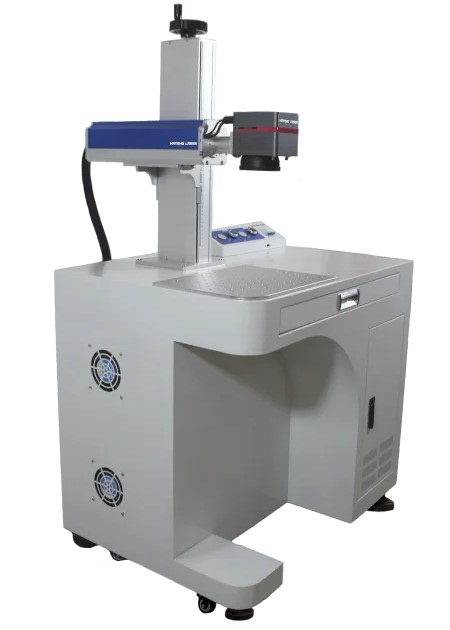
The team assesses your material, industry requirements, and production volume before recommending a system, whether that is the HLF30 fiber laser marking machine for detailed, high-speed marking or the HS107 table top dot pin machine for simpler, rugged serial marking. Every machine is built for Indian industrial conditions and backed by genuine local support.
That practical, industry-aware approach is what makes Hateng Laser a trusted name for marking and engraving equipment across manufacturing sectors. To find the right machine for your industry, talk to our team today and see a demo on your own parts.