
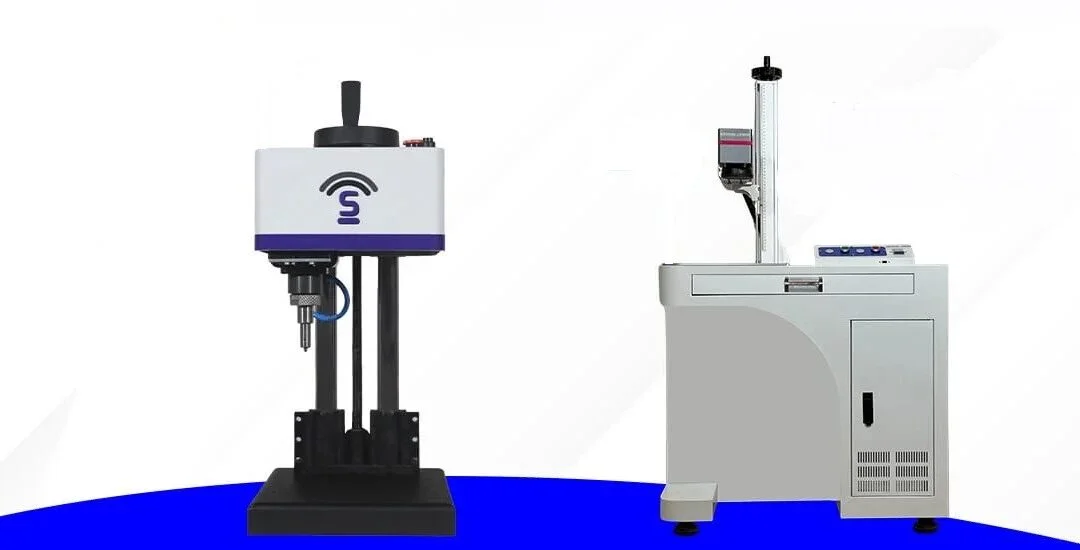
Summary: Laser marking and dot peen marking differ most in five areas, marking depth, speed, noise, versatility, and running cost. Dot peen creates deep, physically indented marks using a striking stylus, ideal for tough, rugged parts, while laser marking is a fast, silent, non-contact process that produces finer detail and handles logos and 2D codes that dot peen cannot. Neither is universally better, the right choice depends on your material, mark type, volume, and working environment.
Buyers new to industrial marking often assume laser and dot peen are interchangeable, just two ways to put a serial number on a part. They are not.
Each technology marks differently, suits different jobs, and carries a different cost structure over its working life. Here are the five differences that actually decide which one belongs on your shop floor.
The 5 Key Differences
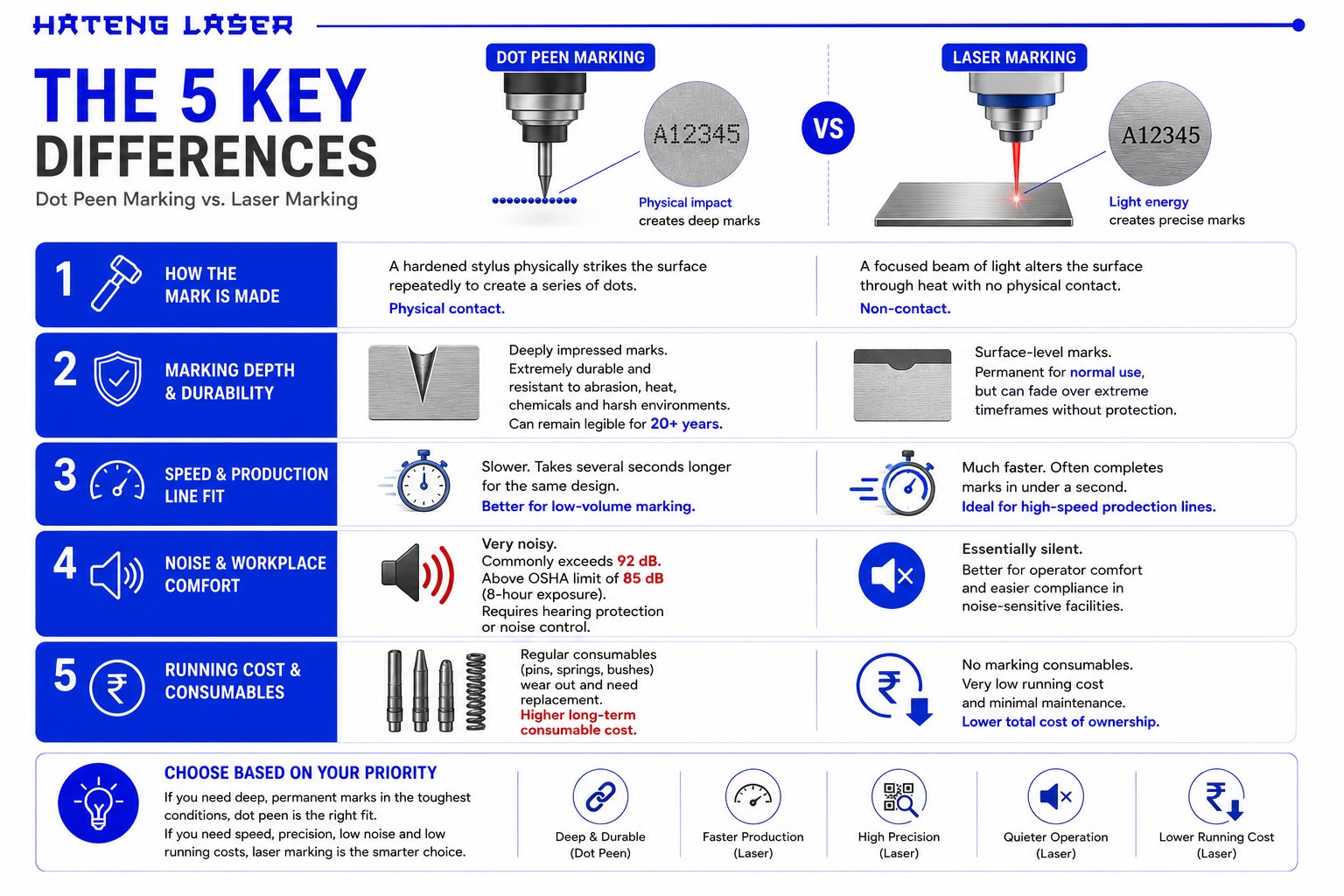
1. How the Mark Is Made
Dot peen marking uses a hardened stylus that physically strikes the material’s surface repeatedly, creating a series of connected dots that form the mark. Laser marking uses a focused beam of light to alter the surface through heat, with no physical contact at all.
This single difference explains most of the other four. A physical strike leaves a deep, tactile indentation. A beam of light leaves a precise, surface-level change. Neither is “better” in the abstract, they simply produce fundamentally different kinds of marks.
2. Marking Depth and Durability
Dot peen marks are deeply impressed into the material and are very durable, abrasion-resistant, heat-resistant, and chemical-resistant, remaining legible even after two decades in harsh conditions. Laser marks sit closer to the surface and, while permanent under normal use, can fade over extreme timeframes without special protection.
For parts headed into shot blasting, hot-dip galvanising, or heavy abrasive wear, the physical depth of a dot peen mark genuinely has an edge. For most standard industrial and commercial applications, though, laser marks are more than durable enough.
3. Speed and Production Line Fit
Laser marking is significantly faster than dot peen, often completing a serial number or code in under a second, while dot peen systems can take several seconds longer for the same design, which matters on a production line. At low volume this difference is barely noticeable. At high daily throughput, it adds up to real time saved.
This is one of the clearest signals for buyers to weigh. If your line runs at speed and marking is a bottleneck, laser wins decisively. If you are marking a few dozen parts a day, the speed gap barely registers in practice.
4. Noise and Workplace Comfort
Dot peen marking is genuinely noisy, and the difference is measurable, not just anecdotal. Dot peen systems commonly exceed 92 decibels during operation, comparable to a lawnmower or motorcycle engine, particularly on hollow steel parts where the metal amplifies the impact sound. That is well above the level considered safe for sustained exposure.
For reference, OSHA’s occupational noise standard requires hearing protection or noise control once average exposure reaches 85 decibels over an 8-hour shift, a threshold dot peen marking regularly crosses on its own. Laser marking, by contrast, is essentially silent, which matters both for operator comfort and for compliance in noise-sensitive facilities.
5. Running Cost and Consumables
Dot peen marking needs occasional stylus tip replacement, a low but ongoing consumable cost, along with more mechanical wear over time due to the repeated striking action. Laser marking has no consumables at all and a laser source rated for tens of thousands of operating hours, making its running cost per mark extremely low over the long term.
The upfront cost tells the opposite story, dot peen machines are considerably cheaper to buy. Which technology is “cheaper” overall depends entirely on your volume and how long you plan to run the machine.
Laser vs Dot Peen: Side by Side
| Factor | Dot Peen | Laser Marking |
| Mark method | Physical stylus impact | Non-contact light beam |
| Depth | Deep, physically indented | Surface-level, precise |
| Speed | Slower, several seconds per mark | Fast, often under a second |
| Noise | Often exceeds 92 dB | Virtually silent |
| Consumables | Stylus tips wear over time | None |
| Detail capability | Basic serials, simple codes | Logos, fine text, 2D codes |
| Upfront cost | Lower | Higher |
Which One Actually Suits Your Shop Floor?
If your parts need deep, rugged marks that survive blasting or galvanising, and your budget is tight, dot peen remains a sound, proven choice. If you need speed, fine detail, 2D codes, or a quieter working environment, laser marking earns its higher upfront cost fairly quickly.
Many workshops end up running both. A dot pin machine for tough, low-volume serial marking, and a laser system for detailed, high-speed, or high-volume work, covers the full range of what a modern shop floor actually needs.
Frequently Asked Questions
Is laser marking always better than dot peen? No. Laser marking is faster, quieter, and more detailed, but dot peen produces deeper, more physically durable marks that survive extreme abrasion better. The right choice depends on your material, mark type, and working environment.
Which is cheaper, laser marking or dot peen? Dot peen machines cost less upfront. Laser marking has a higher initial cost but virtually no consumables and a very low running cost per mark, so which is cheaper overall depends on your volume and how long you use the machine.
Can dot peen marking handle logos and 2D codes? Dot peen can mark basic 2D data matrix codes, but with less fine detail than laser marking. For logos, fine text, or high-resolution codes, laser marking is generally the better technical choice.
Is dot peen marking too loud for a small workshop? It can be. Dot peen regularly exceeds 92 decibels, above the level considered safe for sustained exposure without hearing protection. Laser marking is a quieter alternative worth considering in noise-sensitive or shared workspaces.
Do laser marks last as long as dot peen marks? Under normal industrial use, yes, laser marks are permanent and highly durable. For parts facing extreme abrasion, shot blasting, or galvanising, dot peen’s physical depth still has a slight durability edge over surface-level laser marks.
Why Buyers Trust Hateng Laser
Choosing between dot peen and laser marking is a decision Hateng Laser helps buyers make honestly, based on the actual job at hand rather than pushing the more expensive option by default.
The team assesses your material, volume, and detail requirements, then recommends the machine that genuinely fits, whether that is the HS107 table top dot pin machine or the HLF30 fiber laser marking machine. Both are built for Indian industrial conditions and backed by real local support.
That practical, requirement-first approach is what makes Hateng Laser a trusted name for marking and engraving equipment across engineering and manufacturing. To see how each technology performs on your own parts, talk to our team today and book a demo before you decide.