
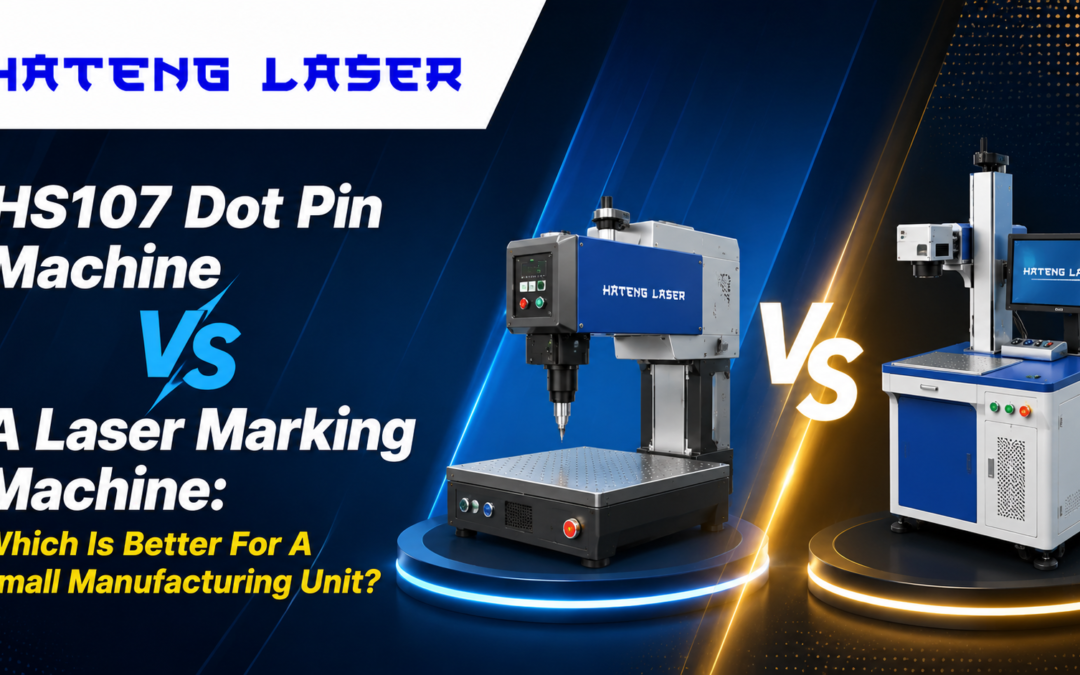
Summary
HS107 dot pin machines create deep, permanent marks on metal. Laser systems deliver faster and cleaner marking results. Dot pin machines often have lower upfront costs. Laser solutions offer higher speed and less consumable wear. The right choice depends on production volume and marking needs. Hateng Laser offers solutions for both growing and established manufacturers.
Introduction
Small manufacturing units need reliable product identification. Every component must be traceable. Every serial number must remain readable. According to recent manufacturing trends, traceability requirements continue to grow across industries, making permanent marking more important than ever.
Many business owners struggle with the same question. Should they invest in a dot pin system or move directly to laser technology? Budget, production speed, maintenance, and material compatibility all influence the decision.
This guide compares the HS107 dot pin machine and laser marking systems. You will learn their differences, benefits, costs, and ideal applications. By the end, you can choose the right solution for your manufacturing unit.
Why do small manufacturing units need permanent marking?
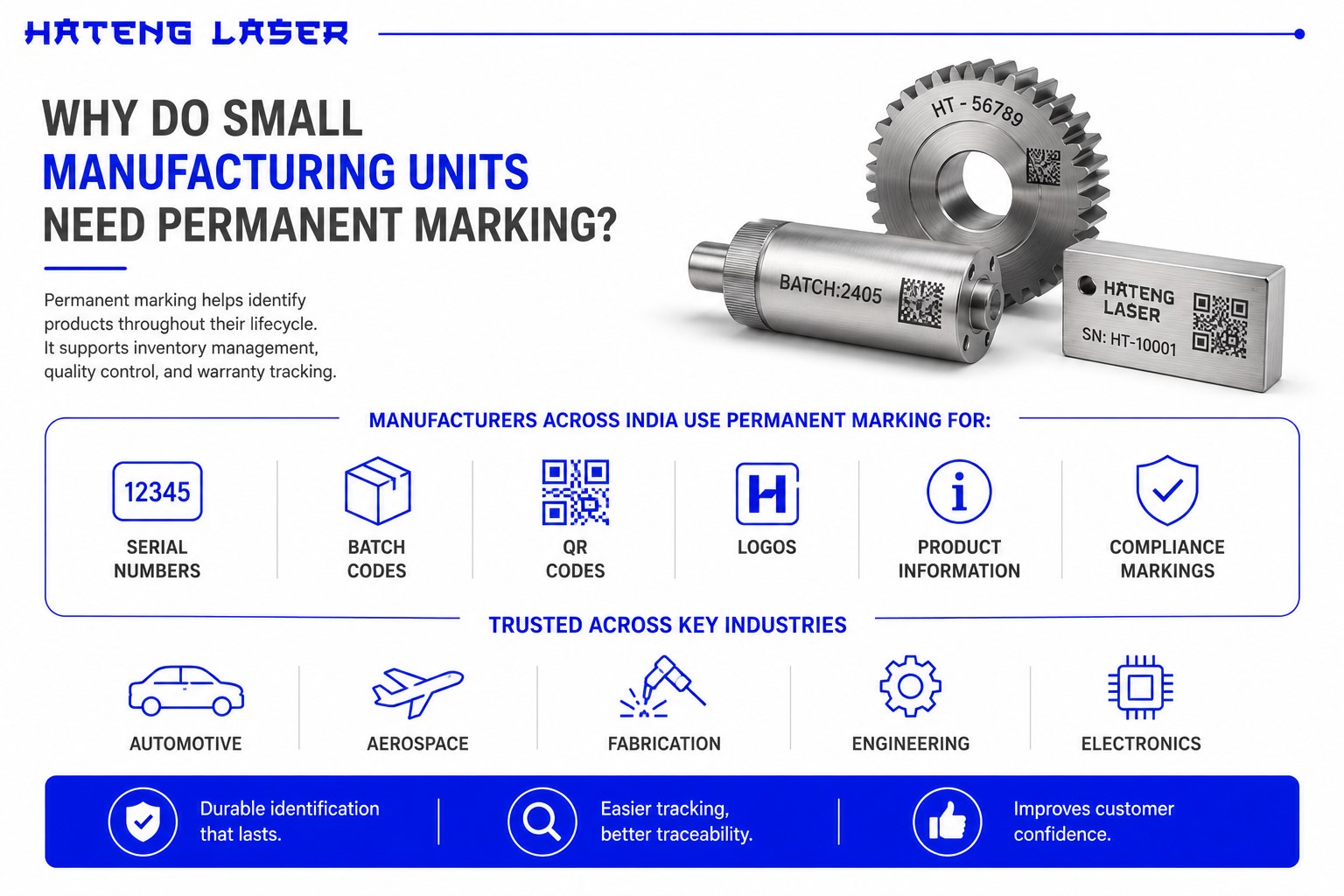
Permanent marking helps identify products throughout their lifecycle. It supports inventory management, quality control, and warranty tracking.
Manufacturers across India use permanent marking for:
- Serial numbers
- Batch codes
- QR codes
- Logos
- Product information
- Compliance markings
Industries such as automotive, aerospace, fabrication, engineering, and electronics rely on durable identification.
A reliable marking system also improves customer confidence. Products become easier to track and verify.
What is the difference between an HS107 dot pin machine and a laser marking machine?
Both systems create permanent marks. However, they use completely different technologies.
The HS107 uses a hardened pin. The pin strikes the surface repeatedly. These tiny impacts create letters, numbers, and codes.
Laser systems use a focused beam. The beam changes the surface without physical contact.
Feature comparison
| Feature | HS107 Dot Pin Machine | Laser System |
| Marking Method | Mechanical impact | Laser beam |
| Contact with Surface | Yes | No |
| Marking Depth | Deep | Shallow to medium |
| Noise Level | Higher | Lower |
| Speed | Moderate | Fast |
| Maintenance | Pin replacement | Minimal wear |
| Surface Finish | Visible indentations | Clean appearance |
| QR Code Quality | Good | Excellent |
| Precision | High | Very high |
For manufacturers producing rugged industrial components, deep marks often matter more than appearance.
For premium products, laser marking usually provides a cleaner finish.
Which option offers better value for a small business?
Budget plays a major role in equipment selection.
A dot pin machine generally requires lower initial investment. This makes it attractive for startups and small workshops.
Laser systems often cost more initially. However, they can improve productivity over time.
Cost and operating comparison
| Factor | HS107 | Laser |
| Initial Investment | Lower | Higher |
| Running Cost | Low | Low |
| Consumables | Pin replacement | Minimal |
| Energy Usage | Moderate | Efficient |
| Operator Training | Simple | Moderate |
| Production Capacity | Medium | High |
A fabrication shop producing steel components may find a dot pin machine sufficient.
A company manufacturing electronic parts may benefit from laser precision and speed.
The decision should focus on long-term production goals rather than purchase price alone.
Which machine performs better on metal parts?
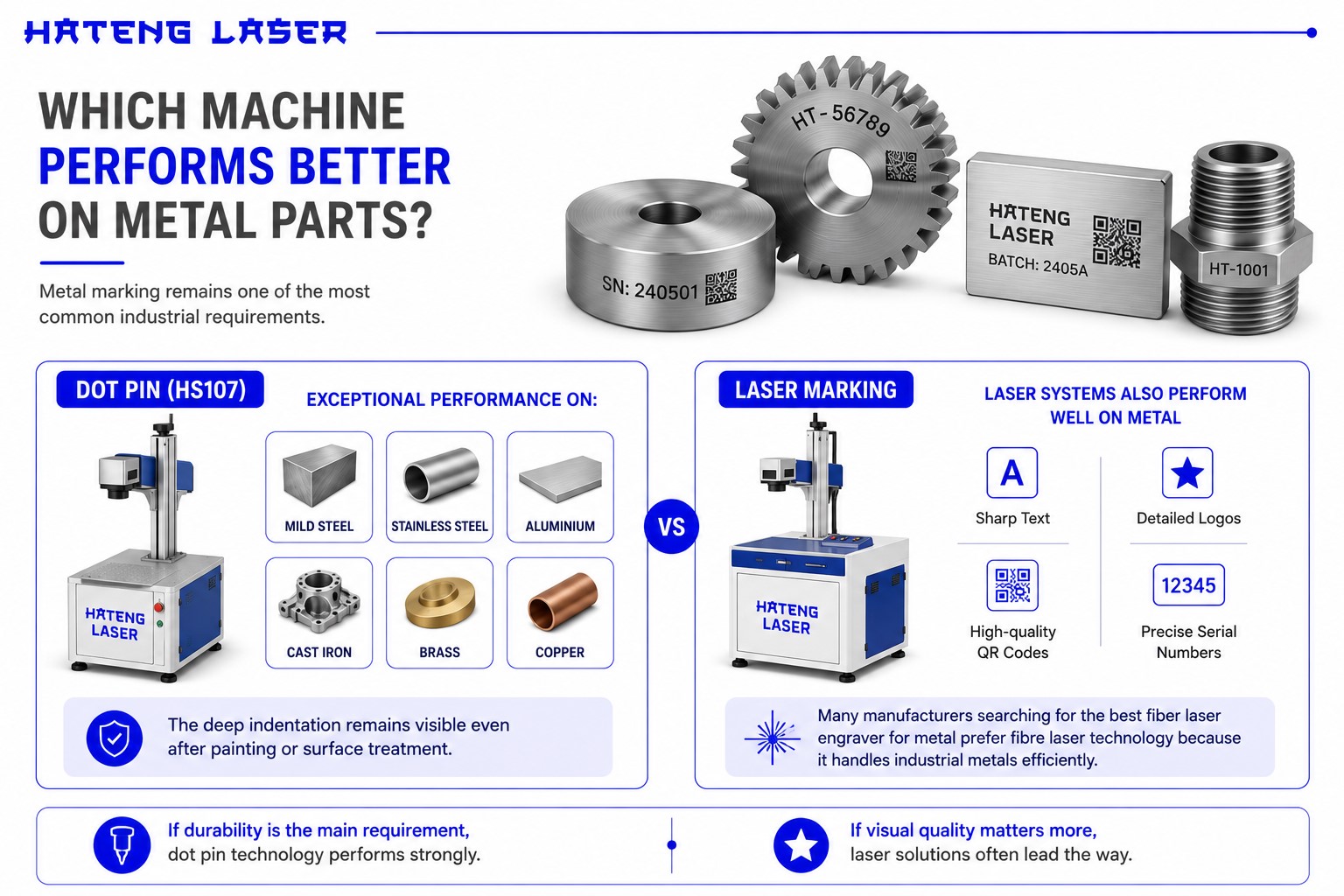
Metal marking remains one of the most common industrial requirements.
The HS107 performs exceptionally well on:
- Mild steel
- Stainless steel
- Aluminium
- Cast iron
- Brass
- Copper
The deep indentation remains visible even after painting or surface treatment.
Laser systems also perform well on metal. Many manufacturers searching for the best fiber laser engraver for metal prefer fibre laser technology because it handles industrial metals efficiently.
Laser marking produces:
- Sharp text
- Detailed logos
- High-quality QR codes
- Precise serial numbers
If durability is the main requirement, dot pin technology performs strongly.
If visual quality matters more, laser solutions often lead the way.
Which industries benefit most from each machine?
Different industries have different marking priorities.
Industries suited for HS107 machines
- Automotive suppliers
- Metal fabrication shops
- Tool manufacturers
- Heavy engineering units
- Steel processing businesses
These sectors often require deep, permanent marks.
Industries suited for laser systems
- Electronics manufacturing
- Medical device production
- Jewellery manufacturing
- Precision engineering
- Consumer products
These businesses often prioritise speed and aesthetics.
Across industrial hubs such as Delhi NCR, Pune, Ahmedabad, Chennai, Bengaluru, and Hyderabad, manufacturers increasingly evaluate both technologies before investing.
Hateng Laser helps businesses identify the most suitable system based on production requirements and future growth plans.
How do you choose the right machine for your manufacturing unit?
The best choice depends on practical production factors.
Ask these questions before investing:
- What materials need marking?
- How many parts are marked daily?
- Is marking depth important?
- Are QR codes required?
- What is the available budget?
- Is future automation planned?
If durability and affordability matter most, HS107 can be an excellent choice.
If speed, precision, and appearance are priorities, a laser system may offer greater value.
Businesses exploring a laser marking machine india solution should consider production targets, material types, and expansion plans before purchasing.
For tailored recommendations, Hateng Laser can help assess your workflow and suggest suitable equipment.
Frequently Asked Questions
Is a dot pin machine better than a laser machine?
Neither is universally better. Dot pin machines create deeper marks. Laser systems offer cleaner and faster marking. The ideal option depends on your application.
Can HS107 mark stainless steel?
Yes. HS107 machines can permanently mark stainless steel with excellent readability and durability.
Is laser marking permanent on metal?
Yes. Laser marks remain permanent under normal industrial conditions and are widely used for traceability.
Which machine requires less maintenance?
Laser systems generally require less maintenance because there is no physical contact with the workpiece.
Can both machines mark QR codes?
Yes. Both technologies can mark QR codes. Laser systems typically provide sharper code quality.
What is the best solution for a growing manufacturing business?
The best solution depends on production volume, material type, and future expansion plans. Many growing businesses choose scalable laser systems.
Conclusion
Both the HS107 dot pin machine and laser marking systems offer reliable permanent marking solutions. Dot pin technology delivers deep, durable marks and lower initial investment. Laser technology provides speed, precision, and premium marking quality.
The right choice depends on your production requirements, growth plans, and budget. Evaluate your workflow carefully before investing.
Hateng Laser provides advanced industrial marking solutions for businesses across India. Whether you need dot pin technology or a laser-based system, our team can help you find the right fit.
Talk to an Expert at Hateng Laser today and discover the ideal marking solution for your manufacturing unit.