Summary
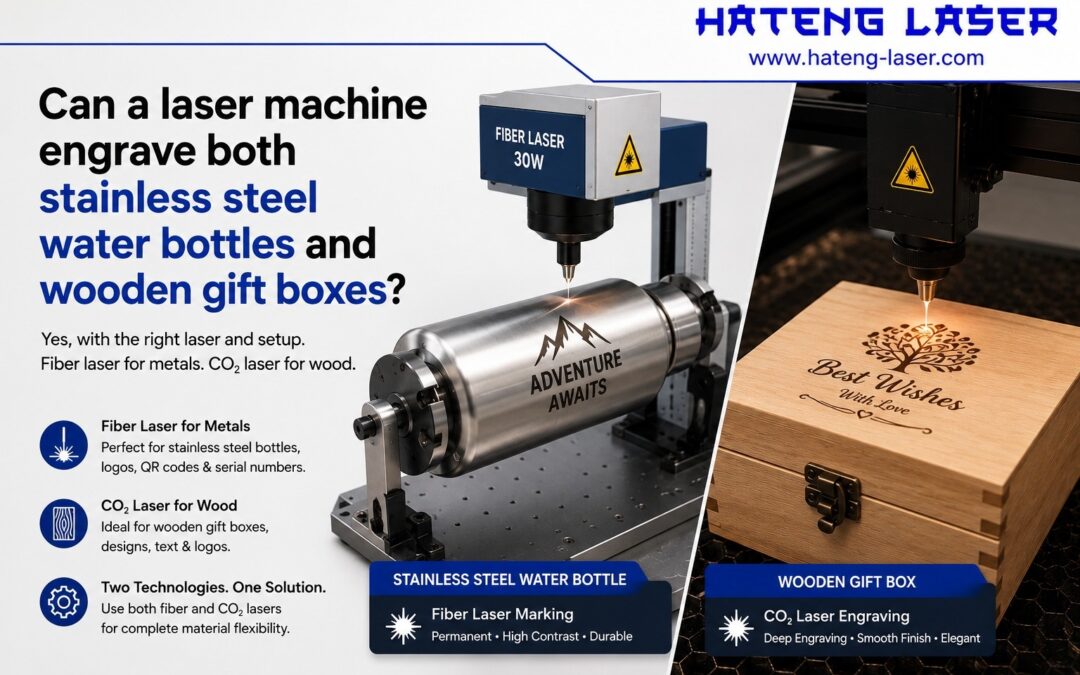
A standard 30W fiber laser marking machine is excellent for stainless steel water bottles. A bare wooden gift box usually needs a CO₂ laser, not a fiber laser. One machine can do both only if you use a mixed workflow or two laser sources. Curved bottles usually need a rotary attachment for clean marking. Hateng Laser’s own guides separate fiber for metal and CO₂ for wood.
Introduction
Custom gifting is growing fast. So is traceable product marking. According to Global Market Insights, the laser marking machine market was estimated at USD 4.1 billion in 2024. That shows strong demand for precise, permanent marking across industries.
Many buyers want one engraving machine laser for mixed jobs. They want stainless steel bottles and wooden boxes done in one setup. The problem is simple. Metal and wood need different laser types.
This guide explains what a 30 watt fiber laser marking machine can do. It also shows where it falls short. You will learn the best setup for bottles, boxes, and mixed gifting work.
Can one laser engrave both materials?
Yes, but not usually with one basic laser source. A fiber laser is built for metals. A CO₂ laser is better for wood and other organic materials. Hateng Laser’s own guide states this clearly.
| Material | Best laser type | Result | Notes |
| Stainless steel water bottle | Fiber laser | Clean, permanent mark | Best with a rotary attachment for curved bodies. |
| Wooden gift box | CO₂ laser | Smooth engraving | CO₂ is strong on wood, paper, cork, and leather. |
| Both in one workshop | Fiber + CO₂ workflow | Flexible production | Best for mixed gifting orders. |
So, the answer is yes in a production sense. But one standard fiber-only machine will not cover both jobs well. A mixed workshop usually needs two technologies or a hybrid workflow.
Why does a 30 watt fiber laser work so well on stainless steel bottles?
Fiber lasers are the go-to choice for direct metal engraving. Metals readily absorb the 1064 nm wavelength. Fiber lasers can create durable marks on stainless steel.
That is why a 30 watt fiber laser marking machine suits water bottles, flasks, and tumblers so well. It can create sharp logos, names, QR codes, and serial marks. Stainless steel is hard, but laser energy can still vaporise or oxidise the surface.
For cylindrical bottles, rotation matters. Tumblers, flasks, and similar round items benefit from a rotary attachment. That keeps the mark aligned across the curve.
Best results on stainless steel bottles usually come from:
- A focused fiber beam.
- A stable rotary fixture.
- A clean, degreased bottle surface.
- A test run before full production.
Why is wood different from stainless steel?
Wood behaves very differently from metal. Hateng Laser’s CO₂ lasers are great for wood, glass, plastics, and leather. Boss Laser also states that CO₂ systems accurately cut or etch wood and other organic materials.
Fiber lasers are less suited to non-metals. Fiber is best for metals. CO₂ is primarily used for non-metal materials such as wood, acrylic, and glass.
That is why a wooden gift box is not a natural job for a fiber-only machine. A CO₂ laser gives deeper visual contrast on wood. It also gives a cleaner finish on packaging and gift surfaces.
This matters for premium gifting. Wooden boxes for weddings, corporate gifts, and festive hampers often need warm, visible branding. CO₂ handles that style better than a metal-focused fiber source.
Which setup should you buy for mixed jobs?
The right setup depends on your product mix. If you only engrave bottles, a fiber system is enough. If you only engrave wood, a CO₂ system is better. If you do both, a dual-machine workflow is the most practical choice.
| Setup | Best for | Strengths | Trade-off |
| 30W fiber laser only | Stainless steel bottles | Fast, permanent metal marking | Not ideal for bare wood. |
| CO₂ laser only | Wooden gift boxes | Clean wood engraving | Not the best direct choice for bare stainless steel. |
| Fiber + CO₂ workflow | Bottles and boxes together | Full material flexibility | Higher setup complexity. |
For mixed gifting orders, the third option is strongest. It gives you clean bottle marking and clean box engraving. It also reduces the need to force one laser to do two different jobs.
Hateng Laser’s own hybrid-marking article supports this approach. It describes combining laser and dot-pin tools in one workflow for flexible industrial output. That same logic applies here. Use the right laser for each surface.
How do you get clean marks on bottles and boxes?
Good results come from setup, not just power. The material must sit still. The focus must be correct. The first mark should always be tested. Hateng also mentions red-light preview and focus tools on its laser setup.
Use this simple workflow:
- Clean the bottle or box surface.
- Secure the part firmly.
- Use a rotary attachment for bottles.
- Run a sample mark first.
- Check contrast, depth, and alignment.
- Keep exhaust and safety controls ready for wood work.
For Indian workshops, this matters a lot. Mixed orders move quickly. One day may include flasks. The next may include corporate gift boxes. A clean workflow keeps production smooth.
Why is Hateng Laser a practical fit for Indian buyers?
Hateng Laser is based in Bhiwandi, Maharashtra. It also manufactures laser marking machines in India. That local base can matter for support, integration, and faster workflow planning.
The brand’s own content also separates machine use by material. Fiber is positioned for metals. CO₂ is positioned for wood and other non-metals. That makes the advice practical, not generic.
For Indian gifting units, this is useful. Many shops need a setup that handles stainless steel flasks, wedding boxes, and branded hampers. Hateng Laser’s material-based approach matches that need well.
FAQ
Can a fiber laser engrave stainless steel water bottles?
Yes. Fiber lasers are ideal for direct stainless steel marking. They produce permanent, high-contrast results, especially when the bottle is held on a rotary attachment.
Can the same machine engrave wooden gift boxes?
Not usually, if it is a standard fiber laser. Wood is better suited to CO₂ lasers, which are designed for organic materials.
Do stainless steel bottles need a rotary attachment?
Usually, yes. Cylindrical items such as bottles, flasks, and tumblers engrave more cleanly with rotation. It keeps the mark even across the curve.
Is CO₂ better than fiber for wooden boxes?
Yes. CO₂ lasers are widely used for wood, paper, cork, leather, and similar materials. They give cleaner results on gift boxes.
Can one workshop handle both bottles and boxes well?
Yes. The best approach is a fiber setup for metal and a CO₂ setup for wood. That gives better quality than forcing one laser to do both jobs.
Conclusion
A single laser machine can do both only in a limited sense. A 30 watt fiber laser marking machine is the right choice for stainless steel water bottles. A CO₂ laser is the right choice for wooden gift boxes. For mixed production, a dual-source workflow is the smartest path. Hateng Laser’s own material guides support that split clearly.
Talk to an expert at Hateng Laser and check the right machine for your bottles and gift boxes.