Summary
For permanent serial numbers on metal, fibre laser is usually the best choice. For a laser marking machine metal setup, fibre gives the cleanest industrial result. CO2 is better for wood, leather, paper, and coated non-metals. In India, entry-level fibre machines can start around ₹1.1 lakh to ₹1.6 lakh. Hateng-Laser lists an HLF130 at ₹1,60,000 ex-works. If you need serial numbers that stay readable, test on your real part first.
Introduction
India’s manufacturing base keeps expanding. According to PIB, manufacturing growth was 5.4% in July 2025 and IIP was 3.5%. That raises the need for permanent marking on parts, tools, and components.
Many buyers face the same problem. They need serial numbers that survive heat, oil, handling, and transport. They also want the right machine for their budget and material.
This guide answers that clearly. You will see which laser marking machine suits serial numbers best, what affects readability, and what the laser engraving machine cost looks like in India.
Which laser marking machine is best for permanent serial number marking?
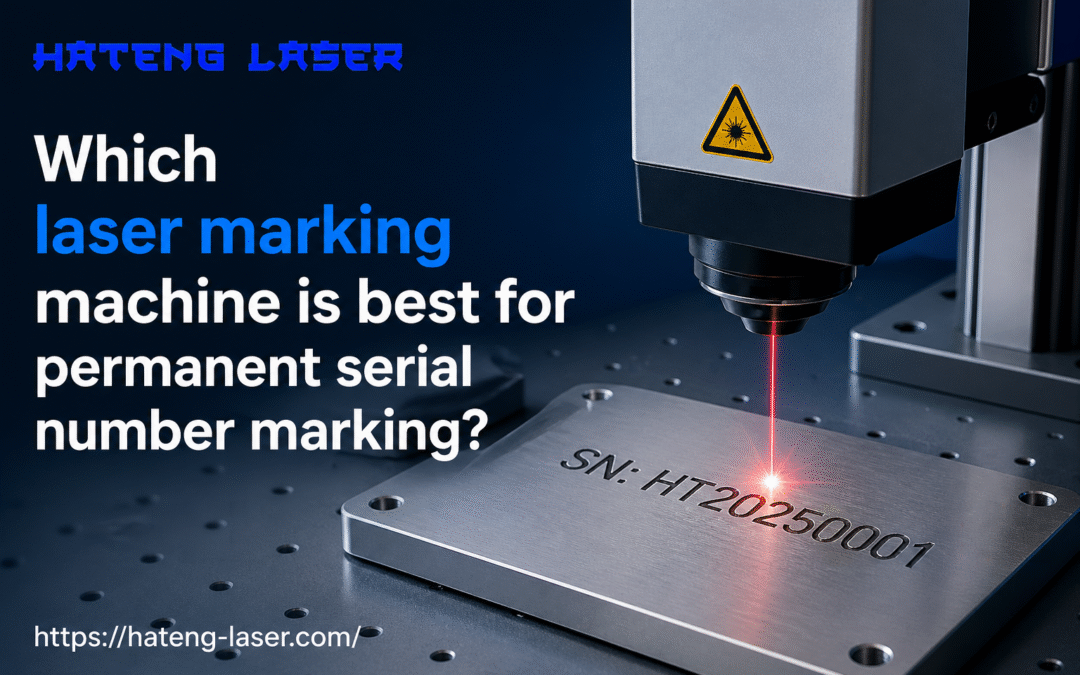
For most metal serial-number jobs, fibre laser is the best option. Hateng says fibre lasers are best for metals and work well for serial numbers, logos, and similar marking tasks.
That makes fibre the strongest choice for permanent identification. It is widely used on stainless steel, aluminium, brass, and titanium. Hateng also says fibre machines deliver clean, permanent marks at high speed.
For buyers searching laser marking machine india, the simple rule is this. If your parts are mostly metal, choose fibre first. If your parts are mostly wood, plastic, or packaging, look at CO2 instead.
Why does fibre laser work better on metal serial numbers?
What makes fibre strong on metal?
Gravotech says fibre lasers are the metal-marking powerhouse. It highlights stainless steel, aluminium, titanium, and brass as strong fits. It also notes fibre’s high precision and speed for fine industrial marks.
Hateng adds that fibre lasers can reach speeds up to 10,000 mm/s in some configurations, while also supporting stable software control. Its fibre laser article also says a 30W unit is a balanced choice for many small and medium jobs.
Feature breakdown
| Feature | Why it matters for serial numbers | Fibre laser fit |
| Permanent mark | Helps trace parts after use | Strong |
| Fine detail | Keeps numbers readable | Strong |
| Metal compatibility | Needed for engineering parts | Strong |
| Speed | Supports production lines | Strong |
| Low maintenance | Reduces downtime | Strong |
| Non-metal use | Needed in mixed production | Limited |
For engineering tools, that matters a lot. Tool bodies, machine parts, and nameplates need marks that stay legible. A fibre laser handles that better than older contact methods.
How do fibre, CO2, and UV compare for serial number marking?
| Laser type | Best for | Serial number marking | Main limitation |
| Fibre | Metals, tools, industrial parts | Excellent | Weak on many non-metals |
| CO2 | Wood, leather, paper, glass, packaging | Not ideal for metal | Poor for direct metal marking |
| UV | Delicate plastics, electronics, medical parts | Good for micro-marks | Higher cost for special use |
Hateng says fibre is best for metals. It says CO2 is better for plastics, wood, glass, and leather. It says UV suits delicate materials and micro-marking.
So the decision is straightforward. For laser marking machine metal use, fibre wins. For packaging or organic materials, CO2 wins. For sensitive electronics, UV may be the better fit.
What should you check before buying in India?
Choosing a machine is not only about price. It is about the part, the mark, and the production load. Hateng says buyers should match material, wattage, marking area, and service terms before purchase.
Buying checklist
- Confirm the main material you will mark.
- Ask for a sample serial number on your actual part.
- Check if the code must be shallow, deep, or high-contrast.
- Review software compatibility and barcode support.
- Compare after-sales support and warranty.
- Check whether the machine fits your floor space.
For Indian factories, this is especially important. A machine for Pune, Ahmedabad, or Chennai should suit real production, not just brochure claims. That is why sample marking matters more than photos.
How much does a laser engraving machine cost in India?
The laser engraving machine cost depends on type, power, and extras. Hateng’s cost guide says entry-level fibre markers in India often start around ₹1.1 lakh to ₹1.6 lakh ex-GST. It also says mid-range systems often sit around ₹2 lakh to ₹4 lakh. Higher-end systems can reach ₹5 lakh to ₹15 lakh+.
| Price band | Typical use | Practical fit |
| ₹1.1 lakh to ₹1.6 lakh | Entry-level fibre marking | Small parts, light industrial work |
| ₹2 lakh to ₹4 lakh | Mid-range industrial systems | Regular serial-number marking |
| ₹5 lakh to ₹15 lakh+ | High-end or specialised systems | High-volume or advanced automation |
Hateng also lists its HLF130 at ₹1,60,000 ex-works. That places it in the entry-level small-industrial band. It is positioned for serial numbers, logos, and similar marking tasks.
So the cheapest machine is not always the best buy. A better machine can reduce rework and rejected parts. That often saves more over time.
Why should Hateng-Laser be on your shortlist?
Hateng-Laser’s site focuses on industrial marking for Indian buyers. It covers fibre laser marking, cost guides, and machine selection for metals. It also says fibre lasers are the right recommendation for metal materials.
The brand also positions its fibre machines for serial numbers and logos. Its 30W fibre laser article says that power level balances power, speed, and cost for many metalwork jobs.
That matters for factories that need a practical starting point. It also matters for SMEs comparing laser marking machine india options. A brand that explains material fit and price bands is easier to shortlist.
Contextual CTA: If you are comparing models, check products and request a live sample on your metal part. That is the fastest way to confirm mark quality and scan reliability.
What do people also ask?
Which laser machine is best for serial numbers on steel?
A fibre laser is usually best for steel. It gives strong contrast, durable marks, and reliable repeatability for industrial serial numbers.
Can CO2 lasers mark serial numbers on metal?
CO2 is not the best choice for direct metal serial numbers. It works better on wood, paper, leather, glass, and coated or organic materials.
What wattage is enough for serial number marking?
Hateng says a 30W fibre laser is a balanced choice for many small and medium jobs. The right wattage still depends on part size, material, and depth.
Why do some serial numbers fade after marking?
Fading usually points to the wrong machine type, weak settings, or poor surface match. Fibre on metal is the safer choice for permanent, readable serial numbers.
Conclusion
For permanent serial number marking, fibre laser is the clear winner in most metal applications. It gives strong, repeatable, and durable marks on engineering parts and industrial tools.
If you are comparing a laser marking machine metal setup in India, start with fibre. If you need to understand laser engraving machine cost, use the price bands, then test your real part.
Hateng-Laser is a sensible shortlist brand for this decision. Its product pages and cost guide make the buying process clearer. Book demo or talk to expert before you place an order.