In the manufacturing and industrial identification world that is precision-focused, laser marking and laser engraving are used interchangeably. Nevertheless, in the case of industry specialists, quality control managers, and entrepreneurs, it is important to know the unique technical differences between the two processes.
You want to know when to mark and when to engrave, whether you are planning to install a high-volume production line with a complete laser marking system or a small table-top marking machine in your small workshop. Knowing when to mark and when to engrave is the first step to optimizing your workflow. This guide is a breakdown of the science, the applications, and the benefits of each to guide you to make the right decision.
What is Laser Marking?
Laser marking is a surface-level process, and it takes place when a low-powered beam of laser light acts upon the surface of a material and changes its properties or appearance slightly. This is aimed at making legibility high contrast without any substantial content left out, and it does not diminish the surface texture.
Laser annealing is the most widespread type of laser marking. The process is common with metals such as stainless steel, titanium, and chrome. The laser warms the material in a localized fashion to form an oxidation layer under the surface, leaving a bold black mark. More importantly, the surface is not rugged.
Other forms of marking are:
- Carbon Migration: This technique is applied to plastics in which the laser heat causes carbon molecules to float to the surface to leave a dark spot on a light material.
- Coloration: A fiber laser marking system can be run by varying the frequency and speed of the marking system, which generates particular colors on particular metals depending on the thickness of the oxide layer.
Key Characteristic: Laser marking is a low-heat, non-invasive process. Laser engraving is often quicker than its counterpart since the laser only has to make one pass over the surface to create a desired contrast.
What is Laser Engraving?
Laser engraving is a process of subtractive manufacturing. Engraving removes the surface as opposed to being marked, which changes it. A laser is considered a non-contact chisel, which introduces extreme heat to the material, and the material is vaporized immediately. This makes a hole or an indent which can be seen and felt.
Since material is getting vaporized, the process is more vigorous and requires a stronger setup. Engraving may be classified as shallow (removal of a surface) and deep engraving (formation of a significant void).
Key Characteristic: Laser engraving produces a permanent, wear-resistant mark. It is used more where parts are to be exposed to severe conditions, e.g., abrasion, sandblasting, or heavy painting, and a surface mark could be lost or damaged over the years.
The Core Differences: Depth, Texture, and Speed
To get a visual clue on the difference, consider the difference between writing on a piece of wood using a permanent marker and cutting your initials in it using a knife. The label is marking–it makes the color different but not the form. The knife is engraved- it alters the geometry of the wood.
- Depth: Laser marking system normally impacts the first 0.001 inches of material. Engraving, in its turn, carves between 0.001 inches and 0.125 inches.
- Texture: When you rub your finger over a laser mark, it is smooth. An engraving is coarse or deeply cut. The reason behind this quality of touch is frequently aesthetic (such as on a custom firearm or jewelry) or functional (such as mold making).
- Speed: Speed is cash in a high-volume area. In most cases, laser marking is much faster since the laser only requires discoloring the surface. Laser engraving is also more time-consuming since the beam needs to linger in order to ablate the material.
Choosing the Right Machine: Size and Versatility
In choosing equipment, the important factor is versatility. Fortunately, because of the modern fiber laser technology, in many cases, one machine can do both, and all that is needed is to alter the power, speed, and frequency.
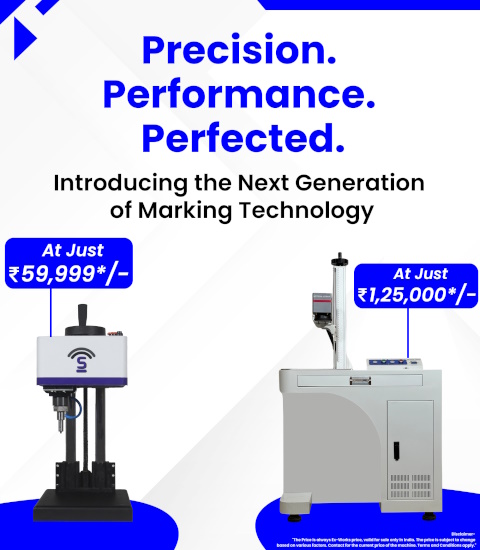
A tabletop marking machine is usually the best solution for small to medium-sized enterprises. These are small units that have the power of an industrial station but can fit on a workbench. The size is not the issue, but a 30W or 50W table-top marking machine can anneal the tool used in surgery with unbelievable precision or can etch a serial number into an automotive engine block.
Applications by Industry
Some of the applications by industry are given below:-
- Medical Industry and Food Industry: Laser marking is the norm. UDI codes and logos can be annealed without leaving crevices in the bacteria.
- Automotive: Engine parts and chassis components are the domain of Laser engraving. VINs and part IDs should be resistant to extremely high temperatures, oil, and vibration.
- Electronics: It is important to mark, and it is not possible to etch a fragile PCB board or a phone case without damaging the internal parts.
- Jewelry: Engraving is used to produce deep and custom designs, and its applications are done with respect to delicate surface logos in Marking.
Conclusion
The decision to use laser marking or laser engraving is eventually a decision to be made based on the functionality of your product. Do you require a smooth and hygienic finish? Go with marking. Do you require a scruffy, tamper-resistant identifier? Engraving is your answer. Fortunately, when you have the right laser marking system, there is hardly a need to compromise, and you will leave the line with a mark of quality on your products.
Give your business the power of precision solutions from Hateng Laser. Find out more about lasting and high-speed marking machines that are meant to improve your quality of production.
FAQs
1. Can one machine do both marking and engraving?
Most fiber laser systems, yes, can do both as they can easily change the power, speed, and frequency parameters.
2. Which process is faster: marking or engraving?
Laser marking is more often than not quicker as it does not take time to remove material as engraving does, as it merely changes the color of the surface.
3. Is laser engraving safe for all materials?
Engraving is most effective on metals, and it can destroy fragile materials such as thin plastics or glass, in which case marking is better.