
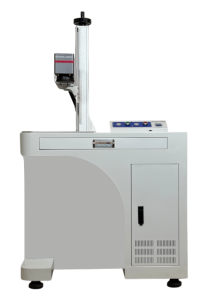
Laser marking leaves permanent and high-contrast marks on non-inked materials without tools. Automobile industries to jewelry ones depend on the accurate parameter settings to achieve quality outputs. A laser marking machine in India provides affordable services to small businesses that are new to this technology.
This manual breaks down the mysticism surrounding power, speed, and frequency, which are the three essential elements in the triangle of power, depth, and efficiency that governs the quality of marks. In the case of both a laser marking machine for metal in VINs and promotional objects, these cracks lead to professional outcomes once mastered.
Laser Marking Fundamentals
Laser marking machines, metal systems atomize the surface material using concentrated beam energy. Fiber lasers prevail (1064nm wavelength), which is suitable for metals such as stainless steel, aluminum, and titanium. CO2 lasers (10.6 0): organics, UV lasers- plastics/ fragile substrates.
The energy is concentrated (10-50W typical) in the beam by its Gaussian shape. Parameters depend on each other: high power cuts deep; high speed lightens marks; frequency pulses edges refine. Furnace environments are ideal to eliminate charring, burrs, or fading.
The manufacturers of laser marking machines in India are offering software interfaces ( EZCAD, Lightburn ) where real-time adjustments can be made, and besides, beginners can easily tune the parameters.
Power: The Energy Driver
Heat input per pulse is dependent upon power (watts). Fiber laser marking engraving machine has an entry level of 20W; an industrial level of 100W+
- Low Power (10-30W): Surface annealing /etching on stainless steel. Formation of an oxide layer without the removal of materials. Best in the case of medical equipment, jewelry serial numbers. Example: at 500mm/s, 20W will form 0.1mm deep black marks on 304 SS.
- Medium Power (30-60W): Deep cutting of hardened steels, aluminum. Removes 0.2-0.5mm material. Tools, automotive parts, 0.3mm deep 300mm/s brass, 50W engraves.
- High Power (60W+): Ablation of superalloys, titanium. Slices anodizing/coatings. Inconel 100W is removed with 1mm+ by Aerospace VINs.
- Overpower risks: micro-cracks, substrate warping, heat-affected zones (HAZ). Always test gradients (beginning 50% power).
- Application Tip: 40-80% power is required in metals, and 10- 30% in plastics; they will melt.
Speed: Trade Quality and Throughput
Dwell time per point is controlled by speed (mm/s). Slower= deeper marks; faster= surface contrast.
- Slow (100-300mm/s) Deep engraving, high contrast. 200mm/s at 50W gives 0.4mm of depth on carbon steel. 90-day barcodes are perfect after the abrasion.
- Medium Speeds (300-800mm/s): production marking. 500mm/s strike depth (0.1mm) and 10 parts per minute throughput. In this case, a laser marking machine for metal is the best when it comes to batch VINs.
- High Speeds (300mm/s to 800mm/s): Annealing, shallow logos. 2000mm/s gives off clean Data Matrix codes that can be read 20m distant.
- Power-Speed Matrix: Speed cuts depth in half. Test matrix: 200/400/800mm/s at 40/60/80 percentage power shows sweet spots.
- Tip Hint: Galvo scanners can do 2000mm/s, XY stages to 500mm/s on significant parts.
Frequency: Pulse Perfection
Pulse/second is determined by frequency (kHz). Increased smooths; decreased forms, dotted lines.
- Low Frequency (1-10kHz): Coarse engraving. 5kHz makes a textured frosted aluminum mark. Heavy penetration (0.5mm and above) on reflective metals.
- Medium Frequency (10-50kHz): Standard marking. 20kHz balances smoothness/depth 20kHz marks fiber laser marking engraving machine. Clean 2D codes, no burrs.
- High Frequency (50-200kHz): Annealing/polishing. Thin oxide layers are vaporized at 100 kHz, producing mirror-finish marks on titanium.
- Pulse Width (ns): Pulse Width (20-100ns) minimizes HAZ; Pulse Width (200ns) maximizes depth. MOPA lasers have a color marking width of 2-500ns, which is adjustable to steel.
- Frequency Effects: 1kHz = dots; 100kHz = straight line. Reflectivity of the matched material kHz, gleaming metal.
Optimal Material-by-material setups
| Material | Power (%) | Speed (mm/s) | Freq (kHz) | Depth (mm) | Notes |
| Stainless Steel | 60-80 | 400-800 | 20-50 | 0.1-0.3 | Annealing black marks |
| Aluminum | 50-70 | 500-1000 | 30-60 | 0.05-0.2 | Anodized removal |
| Brass | 40-60 | 600-1200 | 15-40 | 0.2-0.4 | High contrast yellow |
| Carbon Steel | 70-90 | 200-500 | 10-30 | 0.3-0.6 | Deep engraving |
| Plastic (ABS) | 20-40 | 800-1500 | 50-100 | 0.01-0.05 | Foaming without burning |
| Titanium | 50-70 | 300-700 | 40-80 | 0.1-0.3 | Color rainbow effects |
Workflow Optimization of parameters
- Test Grid: 5×5 Mark grid at constant frequency and power speed variable.
- Measure: depth, contrast, and microscope edge quality.
- Refine: Optimize the ±10% steps; repeat steps, refine, and refine until power spikes.
- Scale: Check on finished components; ambient temperature has an impact on the focus (tolerance of 2 degrees Celsius)
- Software: Pre-set laser marking machine India control panels.
- Several Passes: 2-3 passes, 50% power > single high-power pass. Reduces heat buildup 30%.
Common Beginner Mistakes
Fixed Settings: One size cannot fit all materials.
Dirty Lenses: 50 percent weakening; clean once a week with IPA.
Wrong Focus: ±0.5mm defocus reduces energy density by a half.
Over-Engraving: Engraving too many times over: Engraving kills readability.
Ignoring Exhaust: Fumes etch optics, power falls 20%.
Advanced Techniques
- Color Marking: MOPA fiber laser marking engraving machine adjusts pulse width to steel rainbows (blue/purple at 100-200ns).
- Deep Engraving: 10 passes, 300mm/s, 60kHz removes 1mm of titanium.
- 3D Marking: Varying focus lens forms elevated logos on curved components.
Maintenance of Consistent Parameters
- Every day: Clean optics, check chiller (20 o C).
- Weekly: Check XY axes, test power meter.
- Monthly: Line beam, change diodes (5000hr life)
The laser marking machine metal, with 24/7 support and ready-to-use spares, is the best in India.
Application in Industry Applications
- Auto: VINs withstand 2000 hours of salt spray.
- Medical: UDI codes are passing ISO 15415 Grade A.
- Jewelry: 0.05mm text on 1g rings
- Electronics: QR codes read through paint.
The mastery level of parameters ranges between prototypes and 1000/hr production.
Conclusion
It can take power, speed, and frequency to transform a hobbyist into a professional laser operator overnight. Spend time on batch-wise testing; harvest quality that is of consistent, high contrast; and industrial rating: store templates, failure on documents – parameter mastery = production effectiveness and no costs of rework.
Hateng Laser laser marking machine India upgrade precision upgrade now free parameter demo in India.
FAQs
1. Which are the best metal stainless steel settings of the laser marking machine?
500mm/s, 60% power, 30kHz frequency generates black marks of 0.2mm depth.
2. Which effects does frequency have on the marking engraving machine of fiber lasers?
Greater kHz removes marks; less kHz engraves reflective metals.
3. What is the reason why a laser marking machine in India should be selected by beginners?
Low-cost, stable support, and software accelerate the learning curve of parameter speed.