By Hateng Laser | 9 min read
For metal, fiber wins in most cases. A fiber laser marking machine marks steel, stainless steel, aluminium, brass and coated parts quickly and permanently, and it’s the standard choice for serial numbers, codes and deep engraving. A UV laser is the specialist. It’s better on heat-sensitive plastics, glass and very delicate parts, but it’s rarely the right buy if metal is your main work.
Key insights
- Metal absorbs a fiber laser’s infrared light well: that’s why fiber is the workhorse for metal marking.
- UV is a “cold” process on many materials: it suits parts that can’t take heat, like some plastics and glass.
- Deep engraving is a fiber job: UV sources are typically much lower power and aren’t built for removing lots of metal.
- Match the laser to the material mix: if 90% of your parts are metal, buy for the 90%.
Before you go
Write down every material you’ll mark in the next year, with a rough share for each. If metal tops the list by a wide margin, the UV vs fiber question mostly answers itself. If plastics and glass are a big part of it, that’s when UV deserves a serious look.
If you’ve been researching a laser marking machine in India, you’ve probably come across UV lasers sold as the “premium” option, with talk of cold marking, finer detail and no heat damage. It’s easy to wonder if fiber is the budget choice and UV is the upgrade.
It doesn’t really work like that. UV and fiber aren’t a cheaper and a better version of the same thing. They’re different tools built for different materials, and for metal, the fiber laser is usually the right one.
Let’s look at how each laser works, what each does on metal, and when it’s actually worth paying attention to UV.
What’s the basic difference between UV and fiber lasers?
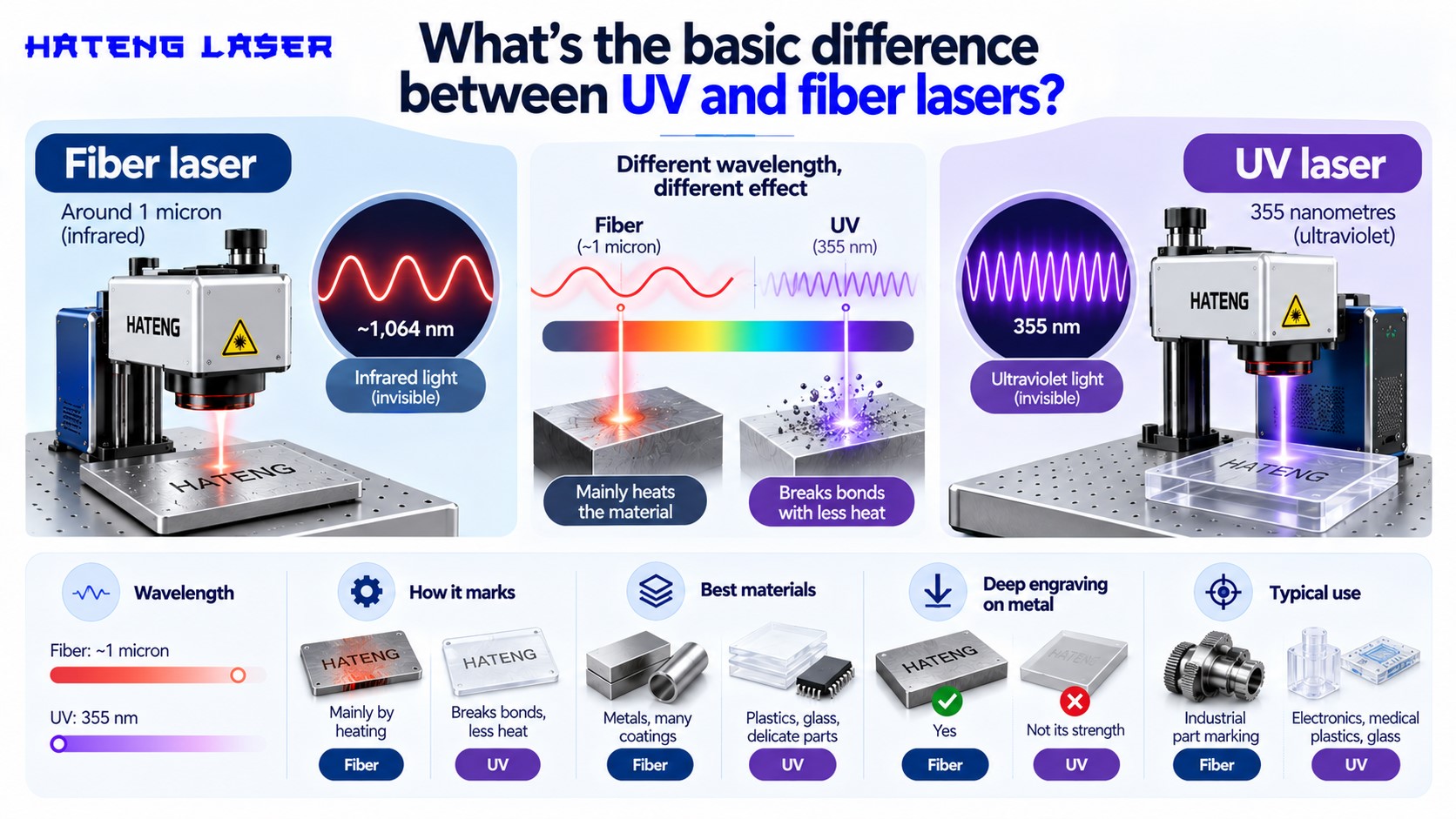
It comes down to the wavelength of light, and how materials respond to it.
Fiber lasers work in the infrared
A fiber laser uses an optical fibre doped with a rare-earth element, commonly ytterbium, as its gain medium. Marking fiber lasers work in the near infrared, around 1 micron, which is invisible to the eye.
UV lasers work at a much shorter wavelength
UV marking lasers usually work at 355 nanometres. A common way to get there is frequency conversion. For example, the third harmonic of an Nd:YAG laser lands at 355nm, and similar conversion is used with other solid-state sources.
Why wavelength matters
Shorter wavelengths carry more energy per photon and can break chemical bonds in many materials directly, with less heat. Longer infrared wavelengths mostly heat the material. On metal, that heating is exactly what you want.
| Fiber laser | UV laser | |
| Wavelength | Around 1 micron, infrared | Around 355nm, ultraviolet |
| How it marks | Mainly by heating | More by breaking bonds, less heat |
| Best materials | Metals, many coatings | Plastics, glass, delicate parts |
| Deep engraving on metal | Yes | Not its strength |
| Typical use | Industrial part marking | Electronics, medical plastics, glass |
How does a fiber laser mark metal?
Fiber is the go-to for metal because metal absorbs its light well and responds predictably to heat.
Annealing
At lower energy, the laser heats steel or stainless just enough to form a dark oxide layer under the surface. The mark is smooth and high contrast.
Engraving
At higher energy, the laser removes material and leaves a recess you can feel. That’s the method for marks that have to survive wear, blasting or coating.
Coating removal
On anodised, painted or powder coated parts, the laser removes the top layer in the shape of the mark, so the metal underneath shows through. Our guide to how a fibre laser marks metal without touching it walks through each of these in more detail.
What does a UV laser do well?
UV deserves credit where it’s due. It’s very good at a particular set of jobs.
Heat-sensitive plastics
Many plastics melt, bubble or discolour under infrared. UV can mark them with far less heat damage, giving clean, fine marks.
Glass and some ceramics
Glass lets most infrared pass straight through. UV interacts with it much better, which is why it’s used for marking glass.
Very fine detail on delicate parts
The short wavelength can be focused to a smaller spot, which suits tiny text and fine graphics on small electronic and medical parts. The overview of ultraviolet lasers from RP Photonics covers the technical side if you want to dig deeper.
Can a UV laser mark metal at all?
Yes, it can, but that’s not why people buy one.
Surface marks are possible
UV lasers can make surface marks on many metals. For light identification on finished parts, that can be enough.
Deep engraving isn’t its job
UV marking sources typically have much lower output power than fiber sources used for metal. Removing metal to make a deep, durable recess takes energy, and that’s what fiber is built for.
Coated metal is a mixed picture
UV can work well on some coatings and paints. On thick powder coats and on deep marks, fiber is usually faster and more practical.
| Metal job | Fiber laser | UV laser |
| Serial number on steel | ✓ Fast, permanent | Possible, slower |
| Dark mark on stainless | ✓ Annealing | Limited |
| Deep engraving | ✓ | ✗ Not suited |
| White mark on anodised aluminium | ✓ | ✓ |
| Thick powder coat removal | ✓ | Slower |
| QR or Data Matrix on metal | ✓ | Possible on finished surfaces |
How do the running and ownership sides compare?
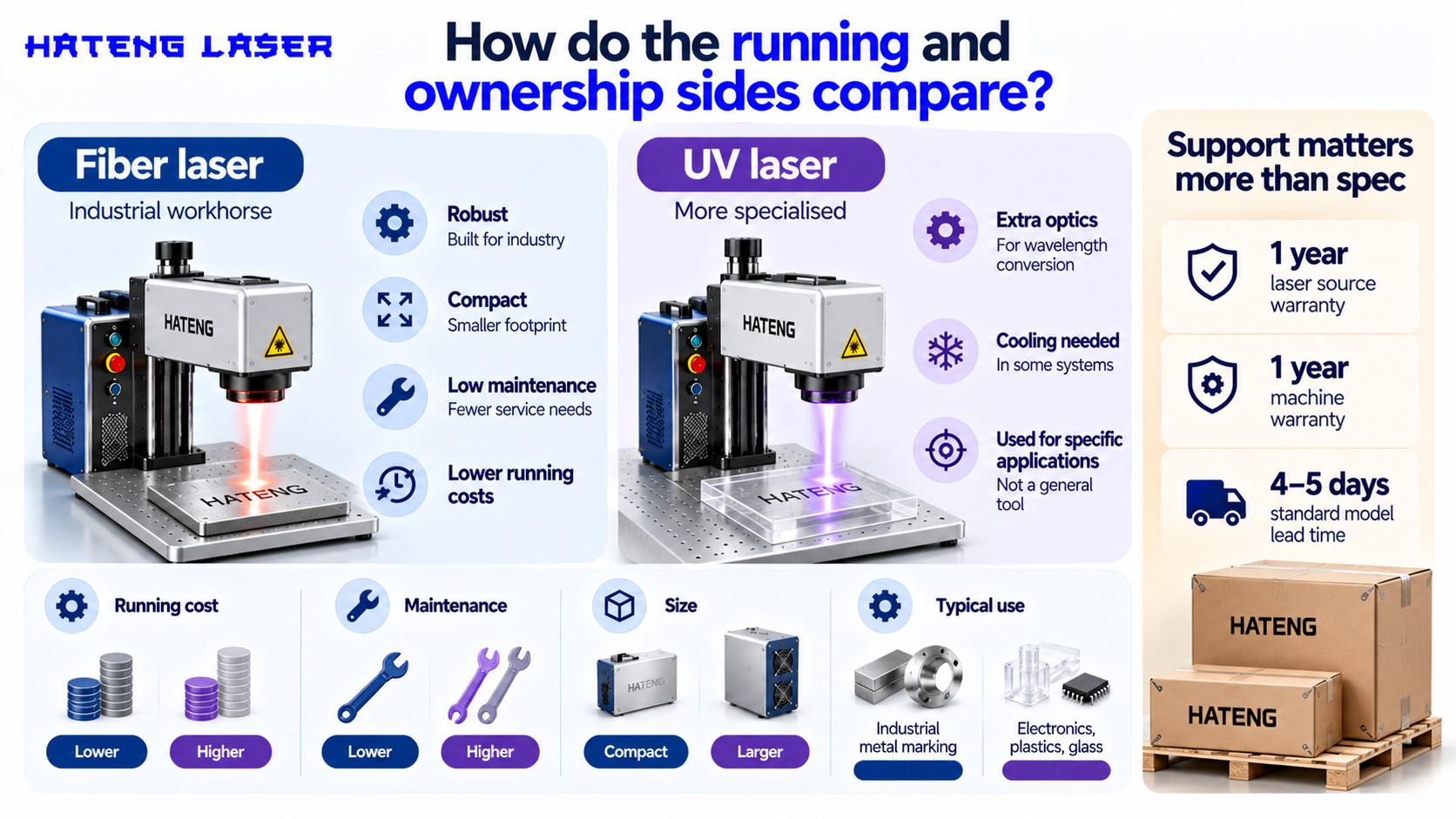
Beyond what they mark, the two lasers also differ in how they live on a shop floor.
Fiber is the industrial workhorse
Fiber sources are known for being robust, compact and low on maintenance, which is a big part of why they dominate industrial metal marking.
UV systems are more specialised
UV sources rely on extra optics to convert the wavelength, and some need cooling. They’re used where their particular strengths are needed, rather than as general shop-floor tools.
Support matters more than spec
Whatever you buy, check what’s covered. Hateng Laser’s HLF30 comes with a one-year warranty on the laser source and a one-year machine warranty, and the standard model’s lead time is 4 to 5 days.
Which industries pick which laser?
Looking at who uses what is a quick sanity check.
Fiber laser users
Auto component makers, tool manufacturers, general engineering, fabrication shops and electronics makers marking metal parts. Serial numbers, part numbers, logos and traceability codes.
UV laser users
Electronics makers marking plastic housings and chips, medical device makers marking plastics, and glass and packaging work.
Shops that end up with both
Plants that mark a real mix of metal and sensitive plastics sometimes run one of each. For a metal-first workshop, though, that’s rarely where you start.
How do you choose between UV and fiber?
Here’s a short checklist to get you there.
Step 1: List your materials
Put them in order of how often you mark them. Metal at the top points to fiber.
Step 2: Check your toughest job
If it’s deep engraving on steel or marking through a coating, that’s a fiber job. If it’s fine marks on a heat-sensitive plastic, that’s where UV comes in.
Step 3: Think about the next few years
If plastics or glass are a growing part of your work, factor that in. If not, don’t pay for capability you won’t use.
Step 4: Test on real parts
A sample mark on your own part tells you more than any spec sheet. Our overview of laser types, fiber, CO₂, UV and green is a good primer before you start asking for samples.
| Your main work | Better choice |
| Steel, stainless, aluminium parts | Fiber |
| Deep engraving and tools | Fiber |
| Anodised and coated metal | Fiber, UV also works on some |
| Heat-sensitive plastics | UV |
| Glass | UV |
| Mixed, mostly metal | Fiber first |
Wrapping up
UV vs fiber isn’t a cheap-versus-premium choice. It’s a choice between two tools built for different materials. For metal, the fiber laser is faster, more versatile and better at deep, durable marks. UV is a fine tool for plastics, glass and delicate parts that can’t take heat.
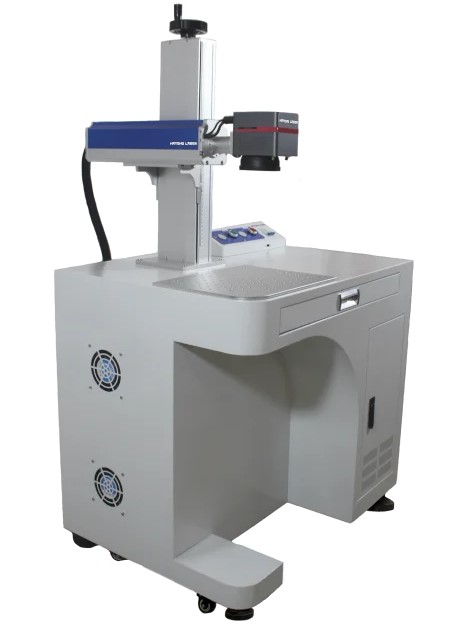
If metal makes up most of what you mark, a fiber laser marking machine is the sensible place to start. Hateng Laser’s HLF30 is a fiber laser specified for serial numbers, QR and Data Matrix codes, logos, deep engraving on metal, and anodised and coated surfaces on tools, auto parts and electronic components.
Send us a few of your parts, especially the toughest one, and we’ll show you what the HLF30 does on them. If your work turns out to be mostly plastics or glass, we’ll tell you that too.
FAQs
Is a fiber laser or UV laser better for marking metal?
For most metal marking, fiber is better. Metals absorb its infrared light well, so it marks steel, stainless and aluminium fast and permanently. UV is better on heat-sensitive plastics and glass than on metal.
Can a UV laser engrave metal deeply?
Not really. UV marking sources usually have much lower power than fiber sources used for metal, so they’re suited to surface marks. For deep engraving on steel or tools, a fiber laser is the practical choice.
Why is UV laser marking called cold marking?
Because its short wavelength can break chemical bonds in many materials directly, with less heating than infrared. That reduces melting and discolouration on heat-sensitive plastics, which is UV’s main advantage over fiber lasers.
Can a fiber laser mark plastic?
Many plastics, yes, but some melt or discolour under infrared heat. For heat-sensitive or very delicate plastics, UV often gives cleaner results. Testing your actual plastic is the only reliable way to know.
What wavelength does a fiber laser marking machine use?
Fiber marking lasers typically work in the near infrared, around 1 micron. That’s invisible, so anyone near an unenclosed machine needs eyewear rated for that wavelength rather than ordinary safety glasses.
Which laser marking machine in India suits a metal workshop?
For a metal-focused workshop, a fiber laser is the usual choice. Look at the source warranty, software, focus and preview tools, lead time and support. Then test it on your own parts before you buy.