By Hateng Laser | 11 min read
A fiber laser engraving machine marks bare metal, anodised aluminium and coated parts in three different ways. On bare steel, it changes the metal itself by heating it to a dark oxide or removing material to make a recess. On anodised aluminium, it clears a thin oxide film to reveal brighter metal. On painted or powder-coated parts, it removes a much thicker layer. The HLF30 is specified for all three, and each needs its own settings.
Key insights
- The beam is the same, the surface isn’t: what sits on top of the metal decides how the mark is made and how it looks.
- Anodising is thin and grown from the metal: a light pass is usually enough to break through and create contrast.
- Powder coating can be many times thicker: expect more energy per mark and plan for the fumes it releases.
- Stainless steel rewards the gentle method: annealing makes a dark mark without cutting into the surface.
Test before you trust
Send your supplier the worst-case version of your part, not the cleanest one. The part with the thickest coating, the darkest anodise or the roughest finish is the one that sets your settings, and a machine that marks it well will handle the rest.
Most application lists for a fiber marker read like a set of equal options: steel, aluminium, anodised parts, coated parts. On the shop floor they’re anything but equal. A setting that gives a crisp code on bare mild steel can barely scratch a powder coat, and one that clears a powder coat can scorch an anodised panel.
That’s why the question “can it mark my part?” always needs a second question behind it: what’s on the surface? The answer changes how deep the laser has to work, where the contrast comes from and how much heat the part can take.
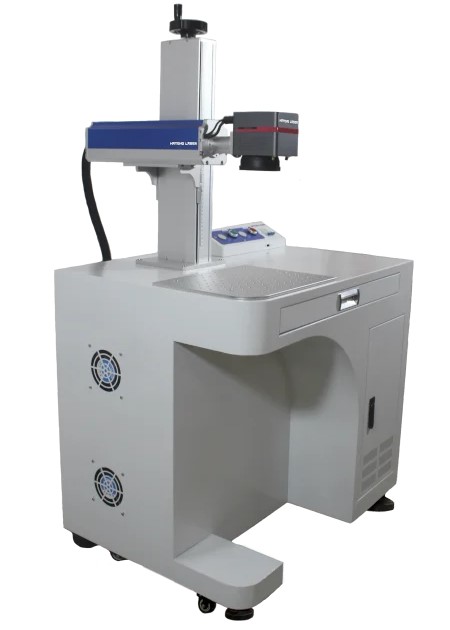
This guide walks through each surface the HLF30 is specified for, explains what physically happens when the beam lands, and ends with a simple way to test your own parts. If you’re weighing up a 30 watt fiber laser marking machine for mixed work, the surface question matters at least as much as the power rating.
Why does the surface change the whole job?
Three things change when the surface changes. Get them right and one machine covers a wide range of parts.
What sits above the metal
Bare metal has nothing on top. Anodised aluminium has a thin oxide layer. Painted and powder coated parts carry a much thicker organic layer. The more there is, the more energy it takes to reach the metal underneath.
Where the contrast comes from
On bare metal, contrast has to be created in the metal itself. On coated or anodised parts, it usually comes from removing a coloured layer so the metal below shows through.
How much heat the part can take
A forged tool shrugs off heat that would discolour a thin sheet or damage an electronic component. Heat tolerance sets the upper limit on how hard you can push.
| Surface | What’s on top | How contrast is made | Main watch-out |
| Bare mild steel | Nothing | Oxide darkening or engraving | Rust on engraved recesses if unprotected |
| Stainless steel | Invisible passive film | Annealing or engraving | Keeping the surface protected |
| Anodised aluminium | Thin grown oxide | Removing the oxide to bright metal | Scorching on darker finishes |
| Painted or powder coated | Thick organic layer | Removing coating to bare metal | Fumes and edge burn |
| Plated parts | Thin metal layer | Removing or darkening plating | Breaking through to base metal |
How does a fiber laser mark bare steel?
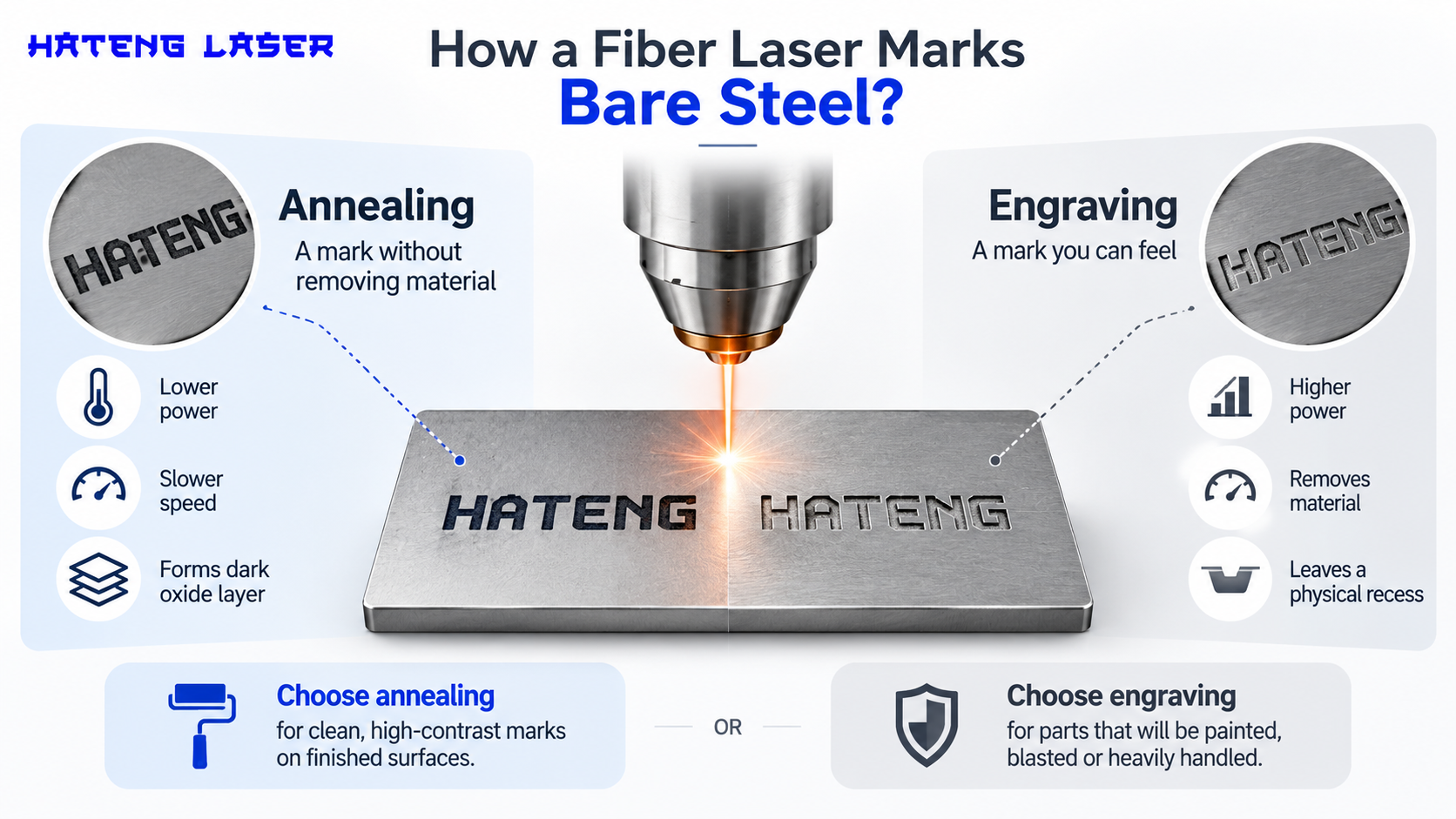
With no layer to remove, the laser has to change the steel itself. There are two ways to do that.
Annealing, a mark without removing material
At lower power and slower speed, the laser heats the surface just enough to grow a dark oxide layer. The surface stays smooth to the touch, and the mark reads as black or dark grey.
Engraving, a mark you can feel
At higher power, the laser removes material and leaves a physical recess. It takes longer, but the mark survives abrasion and handling that would wear a surface mark away.
Choosing between them
If the part will be painted, blasted or heavily handled later, engrave. If it needs a clean, high-contrast code on a finished surface, annealing is usually the better choice.
Why does stainless steel need extra thought?
Stainless steel looks like bare metal, but it has something on its surface that plain steel doesn’t.
The passive layer
Stainless steel’s corrosion resistance comes from a chromium content of 10.5 per cent or more, which forms a microscopically thin, self-repairing chromium oxide film on the surface. That film is what keeps it from rusting.
Why annealing suits it
Annealing heats the surface to create a dark mark without cutting a recess into it, which keeps the finish smooth and easy to clean. That’s why it’s the usual choice for stainless tools, food equipment and parts that go into wet environments.
When engraving is still fine
Deep engraving on stainless is common for tooling and parts that need a mark that can’t be polished away. Check with your customer whether the part needs any surface treatment after marking.
What happens on anodised aluminium?
Anodised aluminium is one of the easiest surfaces to mark well, and one of the easiest to overdo.
The layer is grown from the metal
An anodic coating isn’t painted on top of aluminium; it’s grown from the aluminium itself. The Aluminum Anodizers Council’s reference guide gives minimum thicknesses of 18 microns for Class I and 10 microns for Class II sulfuric acid anodising. That’s thin, so a light, fast pass is usually enough.
Why the mark comes out bright
The laser clears or alters the dyed oxide, exposing lighter aluminium underneath. On black or dark blue anodising, that gives a crisp white or silver mark with strong contrast.
Clear and hard anodised parts
Clear anodised parts give less natural contrast because the oxide and metal look similar. Hard anodised coatings are thicker and darker, so they need more energy than decorative finishes.
How does it handle painted and powder coated parts?
Coated parts are marked by removing the coating in the shape of the mark, so the metal underneath carries the contrast.
The coating is much thicker
Powder coatings are applied far thicker than anodising. DeFelsko, a coating measurement specialist, notes that electrostatically sprayed powder coatings commonly range from 0.001 to 0.010 inches, which is roughly 25 to 250 microns. More layer means more energy per mark.
Clean edges take control
Too little energy leaves a patchy mark with coating still in it. Too much burns the edges of the coating around the mark. The aim is to clear the layer cleanly in as few passes as possible.
Fumes need planning
Burning off paint or powder coat releases more fumes than marking bare metal. A fume extractor at the marking point is essential for this kind of work.
What about plated parts and electronic components?
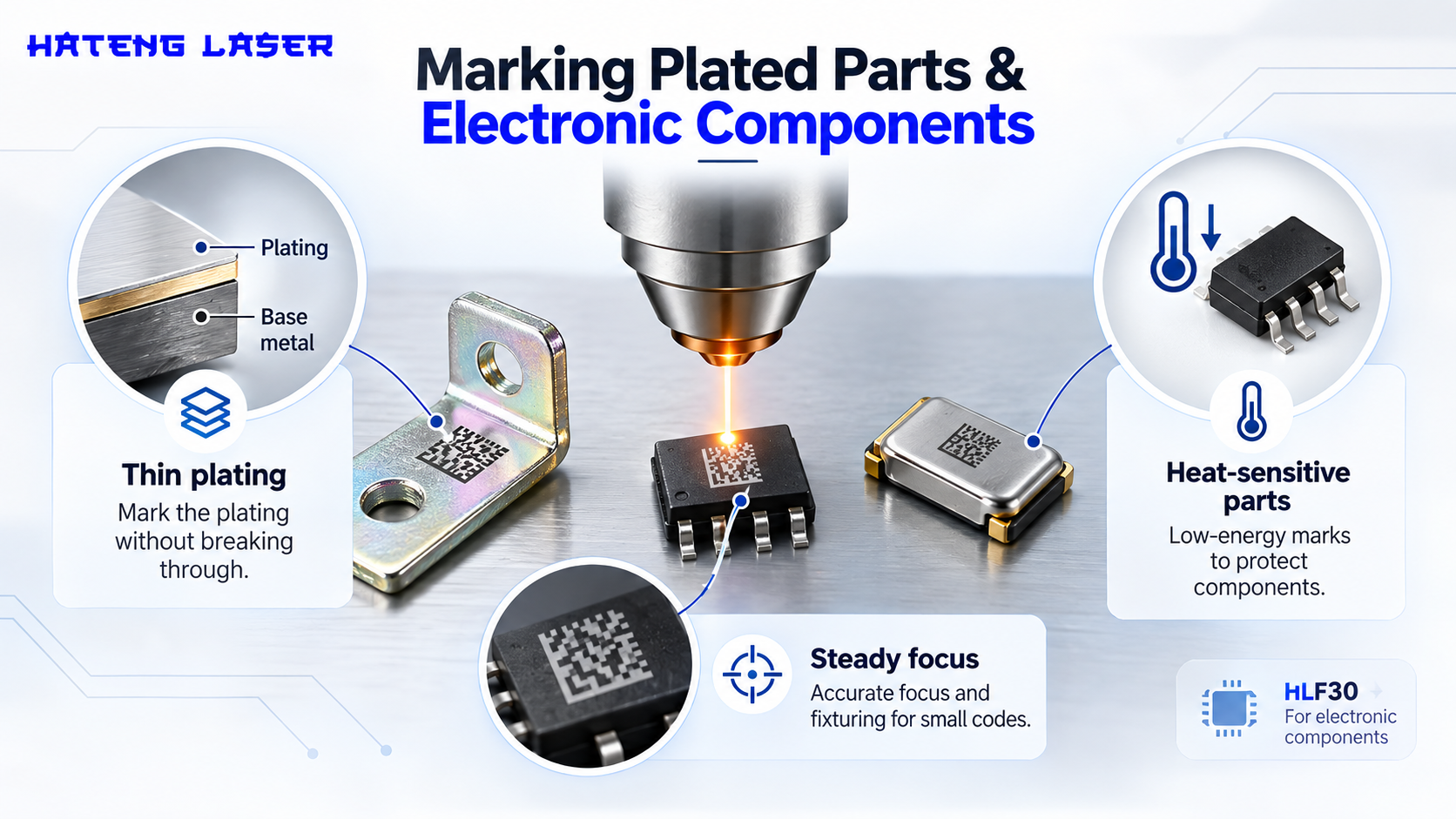
The HLF30 is specified for electronic components, which usually brings plated surfaces and heat-sensitive parts into play.
Plating is a thin layer
Zinc, nickel and similar platings are thin. The goal is usually to mark the plating without breaking through to the base metal, which could affect corrosion protection.
Heat-sensitive parts
Small or thin components can’t take much heat. Short, low-energy marks with fewer passes protect the part while still producing a readable code.
Small codes need a steady focus
Data Matrix codes on small components leave little room for error, so focus height and part fixturing matter as much as power.
When should you engrave deep instead of marking?
Parts that face abuse
Tools, dies and heavy-duty parts that get knocked, cleaned with solvents or blasted benefit from a recessed mark.
Parts that get coated later
A surface mark disappears under paint. An engraved recess can still be read, especially if the coating is thin.
The trade-off is time
Deep engraving takes several passes, so each part takes longer. Mark only what needs to be deep, and anneal or surface-mark the rest.
What goes wrong on each surface, and how do you fix it?
Most marking problems trace back to settings that suit a different surface.
Reading the symptom
| Symptom | Likely surface | Likely cause | First thing to try |
| Faint, patchy mark | Powder coated | Coating not fully removed | More energy or a second pass |
| Brown or burnt edges | Painted or coated | Too much heat at the edge | Faster speed, lower power |
| Mark looks washed out | Clear anodised | Low natural contrast | Adjust settings for a darker or brighter mark |
| Mark fades after cleaning | Bare steel | Surface mark too light | Deeper anneal or light engraving |
| Uneven mark across a part | Any | Focus height varies | Recheck focus and fixturing |
Start with focus
A surprising share of “surface” problems are really focus problems. Check working distance before changing power or speed.
Change one setting at a time
Our beginner’s guide to laser marking parameters explains how power, speed and frequency interact, which makes it much quicker to find the right combination.
How do you test your own parts before buying?
Send real parts
Share samples of each surface you mark, including your hardest one, with the HLF30 enquiry.
Include the worst case
The thickest coating, the darkest anodise and the smallest code set the settings for everything else.
Check what matters to your customer
If a scanner has to read the code, test it with a scanner. If the part goes through cleaning or coating afterwards, test the mark after that step too. Our material-by-material laser marking guide is a useful companion while you plan the samples.
Wrapping up
Bare, anodised and coated metal each ask a different thing of the same beam. Bare steel needs its surface changed, stainless needs a gentle hand to keep its finish, anodised aluminium needs a light pass through a thin layer, and powder coating needs enough energy to clear a much thicker one without burning its edges. Once you think in terms of the surface rather than the metal, the settings start to make sense.
The HLF30 is specified for this whole range, from serial numbers and codes to deep engraving on metal and marking on anodised and coated surfaces, which makes it a practical single machine for workshops handling mixed parts.
If your parts carry more than one kind of finish, send samples of each to Hateng Laser and ask to see how the HLF30 handles them before you decide.
FAQs
Can a fiber laser mark anodised aluminium?
Yes. A fiber laser removes or alters the thin anodic oxide layer to expose brighter aluminium underneath, giving a high-contrast white or silver mark on darker finishes. It usually needs a light, fast pass rather than high power.
Can a laser mark powder coated metal?
Yes, by removing the coating in the shape of the mark so the metal underneath shows through. Powder coating is much thicker than anodising, so it needs more energy, and fume extraction is essential.
What is the difference between laser annealing and engraving?
Annealing heats the surface to form a dark oxide mark without removing material, so the surface stays smooth. Engraving removes material to create a recess you can feel, which lasts better through abrasion and later coating.
Is laser annealing better for stainless steel?
For most finished stainless parts, yes. Annealing creates a dark, readable mark without cutting a recess into the surface, keeping it smooth and easy to clean. Deep engraving is still used where the mark must survive heavy wear.
Why is my laser mark faint on coated parts?
The coating usually hasn’t been fully removed. Check focus height first, then increase energy or add a second pass. Patchy marks on thick powder coats are a settings issue far more often than a machine issue.
Can the HLF30 mark electronic components?
Electronic components are among the HLF30’s listed applications. Small, heat-sensitive parts need short, low-energy marks and steady fixturing, so send sample parts to confirm the mark quality and readability you need.