
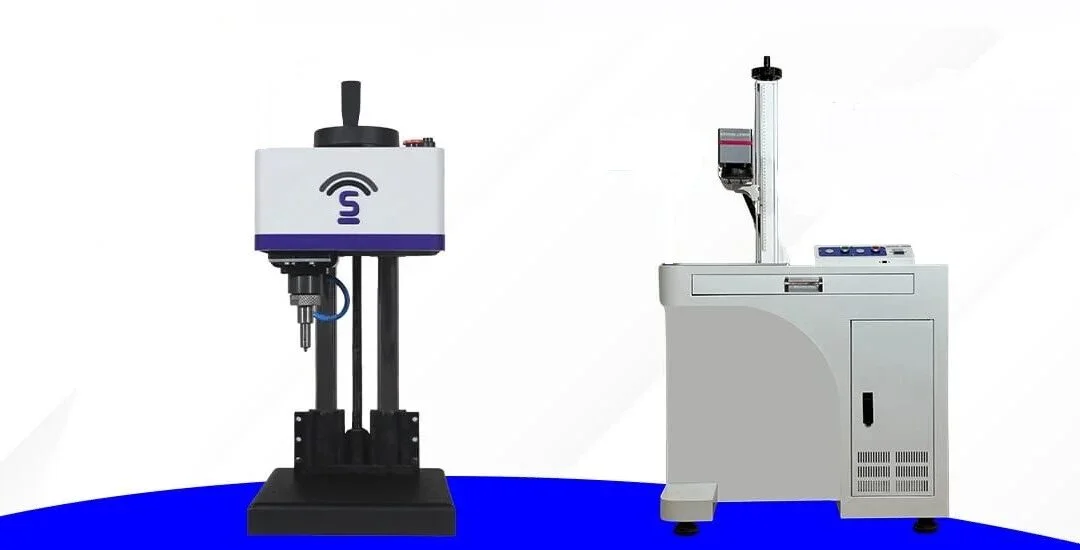
Summary: The five clearest signs it is time to upgrade from dot peen to laser marking are that your marking speed is bottlenecking production, you need finer detail like logos or 2D codes, your parts are too delicate for a physical striking process, noise is becoming a workplace problem, or your consumable and maintenance costs are adding up faster than expected. A dot peen machine that served you well at lower volume or simpler marks can genuinely become the limiting factor as your work changes.
Plenty of workshops start with a dot peen machine, and for good reason, it is affordable, reliable, and simple to operate. The question is whether it still matches the work you are doing today.
If any of the five signs below sound familiar, it is worth seriously weighing a fiber laser marking machine instead of assuming your current setup is fine because it always has been.
The 5 Signs to Watch For
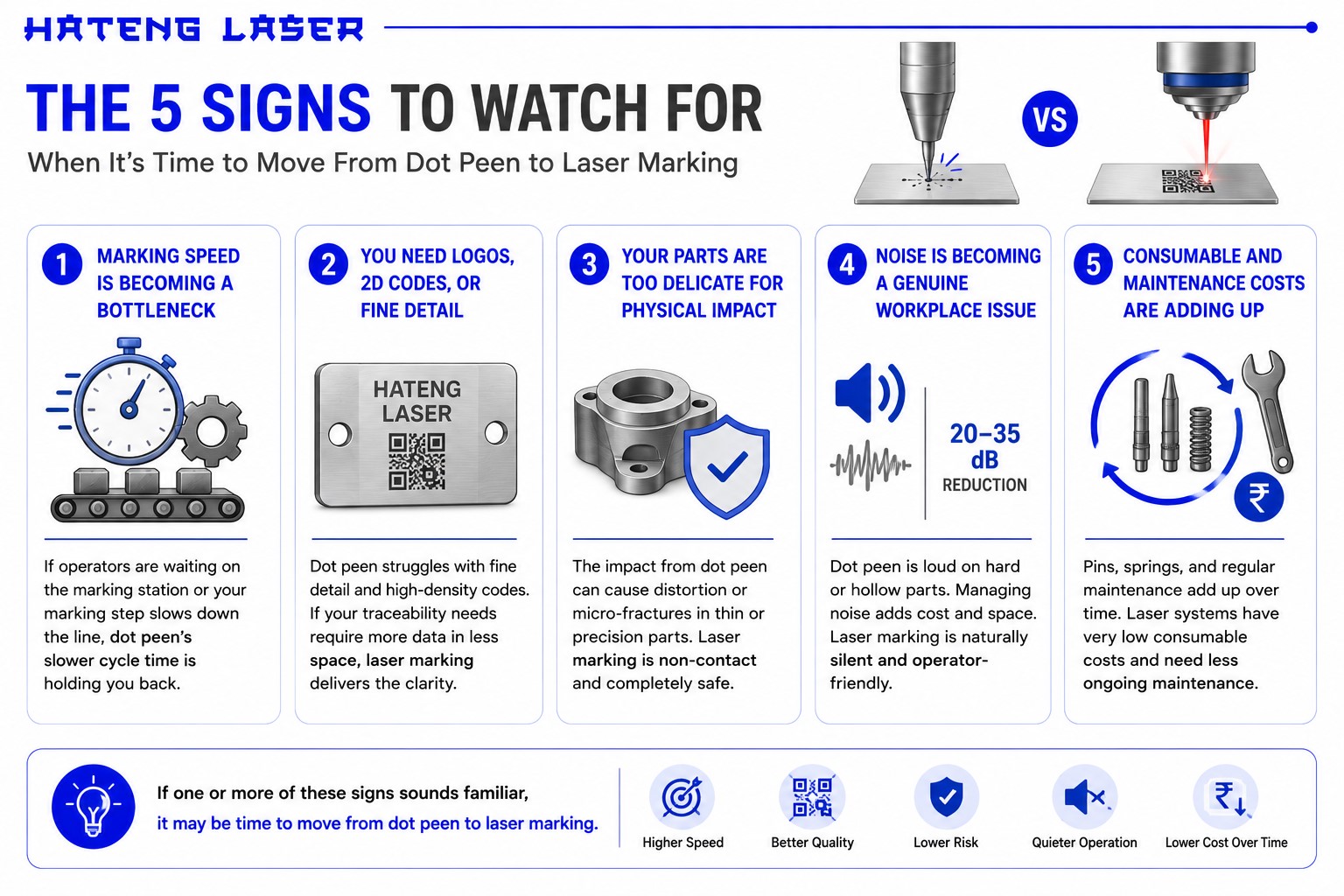
1. Marking Speed Is Becoming a Bottleneck
If operators are waiting on the marking station, or your marking step visibly slows down an otherwise fast production line, that is a clear signal. Dot peen systems can take several seconds longer per mark than a laser system completing the same design, and at scale, that time gap compounds across an entire shift.
If you are marking dozens of parts a day, this rarely matters. If you are marking hundreds or thousands, it starts to matter a great deal.
2. You Need Logos, 2D Codes, or Fine Detail
Dot peen marking handles basic serial numbers and simple codes reasonably well, but it struggles with fine detail, small text, and high-resolution 2D data matrix codes. If your customers or quality system now require finer, more information-dense codes than a basic serial number, dot peen is working near its technical ceiling.
Laser marking produces sharp, high-resolution marks regardless of how much detail is packed into a small area, which matters increasingly as traceability requirements move from “a number” to “a scannable code carrying batch, date, and part data.”
3. Your Parts Are Too Delicate for Physical Impact
Dot peen marking works by physically striking the material, which is exactly the problem for thin-walled components, precision-machined parts, or anything where the stress of repeated impact risks distortion or micro-fractures. Some parts simply cannot tolerate that kind of physical contact.
Laser marking, being entirely non-contact, avoids this issue completely. If you have started avoiding marking certain parts with your dot peen machine because of damage risk, that is effectively already telling you the technology has reached its limit for your work.
4. Noise Is Becoming a Genuine Workplace Issue
Dot peen marking is loud enough on hollow or hard components that many facilities cannot simply leave it unmanaged. If your facility has grown, added more stations near the marking area, or simply has operators complaining about the noise, that is a legitimate reason to look at alternatives.
Beyond comfort, there is a real operational cost to managing dot peen noise properly. A well-designed acoustic enclosure typically reduces marking noise by 20 to 35 decibels, which is effective but adds cost and floor space that a naturally silent laser system avoids from the outset.
5. Consumable and Maintenance Costs Are Adding Up
Dot peen machines need occasional stylus tip replacement, and the repeated mechanical striking action means more wear over time compared with a non-contact process. Individually, these costs look small. Over a few years of heavy use, they add up in a way that is easy to underestimate until you actually total the maintenance invoices.
A fiber laser marking machine, by contrast, has no consumables at all. A 30W fiber laser source running a typical eight-hour, five-day working week can operate for more than 20 years before any noticeable power decay, which shifts the cost structure heavily in favour of running cost once the higher upfront price is paid off.
Is It Time to Upgrade? Quick Self-Check
| Sign | If This Is True, Consider Upgrading |
| Speed | Marking visibly slows your production line |
| Detail | You need logos, 2D codes, or fine text |
| Part fragility | You avoid marking certain delicate parts |
| Noise | Operators or neighbours are affected |
| Running costs | Consumables and wear are adding up |
You Don’t Have to Fully Replace Your Dot Peen Machine
Upgrading to laser marking does not necessarily mean retiring your dot peen machine entirely. Many workshops keep both, using dot peen for simple, rugged, low-volume marks where its depth genuinely suits the job, and a laser system for everything else where speed, detail, or part sensitivity matter more.
Think of it less as a replacement decision and more as adding the right tool for the work that has outgrown your current one.
Frequently Asked Questions
How do I know if my production volume justifies a laser marking machine? If marking noticeably slows your line, or you are marking in the hundreds to thousands of parts daily, the speed advantage of laser marking typically justifies the higher upfront cost. Lower, steadier volumes may not need the upgrade yet.
Can a laser marking machine mark the same materials as my dot peen machine? In most cases, yes. Fiber laser marking machines handle the same metals, steel, aluminium, brass, and more, that dot peen machines mark, generally with finer detail and no physical contact with the part.
Is upgrading to laser marking expensive? The upfront cost is higher than a dot peen machine, but running costs are significantly lower with no consumables and minimal maintenance. Over a few years of steady use, the total cost gap often narrows considerably.
Will switching to laser marking slow down my team while they learn it? Not for long. Laser marking software is generally straightforward, and most operators pick up the basics within a day or two of training, especially if they already understand the marking designs they are working with.
Do I need to replace my dot peen machine completely, or can I run both? Running both is common and often the most practical approach. Keep dot peen for simple, rugged, low-volume marking, and add a laser system for detailed, high-speed, or delicate-part marking.
Why Buyers Trust Hateng Laser
Recognising when it is time to move beyond dot peen is exactly the kind of decision Hateng Laser helps buyers work through honestly, rather than assuming every upgrade needs to happen immediately.
The team looks at your actual production volume, detail requirements, and part sensitivity before recommending anything, matching you to the HLF30 fiber laser marking machine only where it genuinely earns its cost over your current HS107 or equivalent dot pin setup. Every machine is built for Indian industrial conditions and backed by real local support.
That honest, needs-first approach is what makes Hateng Laser a trusted name for marking and engraving equipment across engineering and manufacturing. If any of these five signs sound familiar, talk to our team today and see a laser demo on your own parts before you decide.