
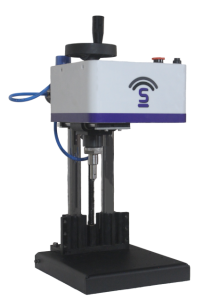
Traceability and product identification in the fast-moving manufacturing world are a must. Dot pin marking machines are economical, entry-level, and permanently marking machines. These miniature tools create human-readable text, logos, barcodes, or Data Matrix codes by marking dots on materials such as metal, plastic, and composite with a pneumatic or electric stylus.
But what are their comparative accuracy and speed? In this blog, we explore the aspect of realistic expectations, and you have an opportunity to check whether a dot pin machine that is friendly to beginners is suitable for your workshop or production line.
Entry-level models are excellent in small shops, prototyping laboratories, and compliance-oriented industries such as automotive, aerospace, and medical devices. They do not need a fume extraction system or a line of sight system, like a laser, and thus are perfect in tight areas.
Precision In Its Bones: Expectation of Accuracy
The value of a marking system is precision; poor marks would either result in recalls, fines, or rework. Dot pin machines at the entry level are usually able to mark to a position of 0.05 mm to 0.1 mm due to stepper motors and carbide-tipped pins. It amounts to sharp 0.2-0.5 mm dot sizes, ideal in 2D codes readable by conventional scanners.
As an example, for stainless steel, the repeatability of characters as small as 1 mm high is expected to be within ±0.05 mm. Lighter metals, such as aluminum, tolerate even closer tolerances, usually to less than 0.03 mm deviation. Such aspects as surface finish are essential: polished objects are sharper than rough-cast ones. This is supplemented with the highly developed software in these machines to create a consistent depth of 0.01-0.5 mm with auto-focus and vibration damping.
Entry-level units are inexpensive compared to more expensive models and have reduced micro-precision. They can work with fonts as small as 5×5 dot matrices up to TrueType scalability, though upgrades are required to work with ultra-fine work (e.g., 0.01 mm in microelectronics).
Speed That Keeps up: Cycle Times and Throughput
Speed is what distinguishes non-heroic marks from the production heroes. Dot pin marking at the entry level runs at 20-60 characters per second (CPS) under optimal conditions (full 2D codes, 50x 50 dots), and requires 5-15 seconds. Pneumatic models reach 40 CPS on steel, and the electric ones can do 30 CPS quieter with finer control.
A cycle time is dependent on depth, material, and force. Plastic engravings can be done using light at 60 CPS; deep cuts in hardened steel require 20 CPS. An average 20-character serial on aluminum? Under 2 seconds. Here, batch processing files up to 100 parts in the queue using USB or Ethernet in order to run the parts unattended.
Entry-tier dot peen engraving machines increase the speed by using solenoid-driven pins up to 50 CPS bursts. They are noisier, but are also better at high-volume marking, such as engine blocks.
Manufacturers have real-world benchmarks with 80-90% uptime with pin changes every 6-12 months. Inline speed combinations with PLCs project 10-20 seconds per part assembly lines. Drawbacks? Variable pressures cause pneumatics to run slowly, use closed-loop electronics at a constant 35 CPS.
Balancing Act: Trade-Offs and Practice
Precision and speed are dynamic. Deepen marks (0.3 mm+), push, and halve speed – but challenging environment durability is skyrocketing. This is maximized in entry-level dot peen engraving machines, which have adjustable force (50-500 N) and which can be dialed at 0.07 mm at 40 CPS.
They are fine in factories: Automotive stores number chassis numbers within 8 seconds; medical companies cut implants with precision acceptable by the FDA. A dot pin machine on a bench is used to etch tools as part of traceability, and beating hand stamping is much faster (10x) and has fewer errors (under 0.5 percent).
Value amplification Cost savings: 0.83/ part vs. outsourcing, 41.50. It is easy to maintain: Clean every week, change pins at 1660. Energy use? Under 100W, greener than lasers.
Performance optimization: Best practices when using entry-level users.
To achieve the maximum accuracy and speed:
- Software mods: Optimize paths: use preview modes.
- Fixturing: Clamps minimise vibration and increase precision 15% higher.
- Upgrades: included rotary axes of parts with cylindrical parts without loss of speed.
The need to have enterprise budgets in order to be able to achieve professional results is proven with the entry-level dot peen engraving machines and tabletop marking machines. They provide 95% of the best performance at 30 percent of the cost.
Conclusion
Finally, the entry-level dot pin marking machines, table top marking machines, and dot peen engraving machines achieve a remarkable compromise in 0.05-0.1 mm accuracy and 20-60 CPS speeds- ideal for cost-sensitive manufacturers who want reliability. These workhorses enhance traceability, reduce expenses, and expand easily. Always aim to exceed expectations and invest in the proven performance today and future-proof your operations.
Buy the Hateng Laser precision speed marking game upgrade to dot pin masters. Call us now to get a free demonstration and 10% discount on entry-level models.
FAQs
1. In what ways would a dot pin marking machine be compared to a laser in accuracy?
Dot pin machines at the entry level have a 0.05-0.1 mm accuracy through mechanical indentation, comparable to lasers on metals, but making them better on rough surfaces. No optics required, meaning no recalibration needed to maintain a constant depth. Ideal for rugged shops.
2. What is the maximum speed of a tabletop marking machine?
Tabletop models were 40-60 characters/second on soft metals and 510 seconds for 2D codes. A smaller size is more appropriate for benches, which can process 300 or more parts/hour through software queues. Mute electrics are better than pneumatics.
3. Do dot peen engraving machines at the entry level work with hard material?
Yes, at 300-500N force, they are marked with hardened steel to 45 HRC at 20-30 CPS and 0.1 mm marking error. Carbide pins have a life span of 100000 cycles; regulate depth to achieve speed balance.